NIHB Virtual Counselling Guide
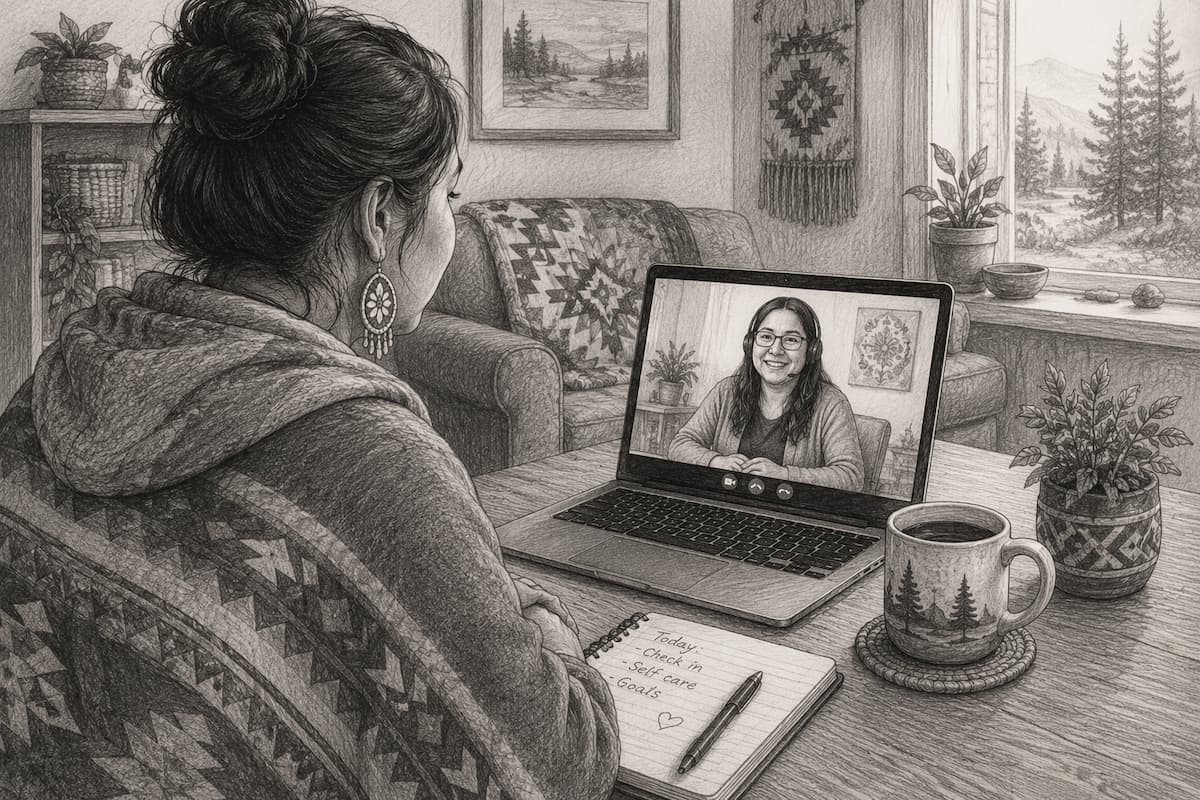
You probably don't realize that the NIHB program covers up to 22 hours of virtual counselling each year, often without requiring prior approval for your first sessions. If you're an eligible First Nations or Inuit client, you can access individual, couples, or family support for trauma, anxiety, and more.
But not every session qualifies, and the rules around providers and provinces aren't always obvious.
Key Takeaways
- NIHB virtual counselling covers individual, couples, family, and crisis sessions for trauma, PTSD, depression, anxiety, grief, substance use,and more.
- Eligibility requires registered First Nations or recognized Inuk status, proven via status card or NIHB client identification, regardless of income.
- Clients receive up to 22 counselling hours (about 20 sessions) yearly, resetting January 1st with no carryover.
- Sessions must use synchronous, real-time video or audio; emails, texts, and pre-recorded messages do not qualify.
- The first 2 hours are pre-approved, while sessions 3 through 22 require a clinical diagnosis and treatment plan.
What NIHB Virtual Counselling Covers
When you're looking into mental health support through the Non-Insured Health Benefits (NIHB) program, it helps to know exactly what virtual counselling can include. You can access individual sessions for adults, youth, and children, plus couples counselling for relationship strain, communication issues, or separation and divorce adjustment.
Family counselling addresses parenting challenges, intergenerational impacts, and household conflict, while short-term crisis and stabilization support helps you through acute distress or major life events. There's also dedicated care around fertility, pregnancy, birth trauma, and postpartum mental health concerns.
The concerns covered are broad. You can seek help for trauma, complex trauma, and PTSD linked to colonization, residential schools, violence, and accidents.
Counselling also addresses depression and low mood, anxiety, panic, phobias, and chronic stress, along with grief and bereavement, including community tragedies, suicide loss, and miscarriages. NIHB coverage allows for 22 hours or more of counselling per year.
Substance use and addiction concerns are supported too, including relapse-risk planning through mental health counselling.
Are You Eligible for NIHB Counselling?
Wondering whether you qualify for NIHB mental health counselling? The program covers eligible First Nations and Inuit clients who are residents of Canada. You qualify if you're a First Nations person registered under the Indian Act (a Status Indian) or an Inuk recognized by an Inuit land claim organization.
NIHB mental health counselling covers eligible First Nations and Inuit clients who are residents of Canada.
Children under 2 also qualify when at least one parent is NIHB-eligible, with the expectation that status or recognition will follow.
Your eligibility doesn't depend on your employment status, income, or whether you live on- or off-reserve. None of those factors disqualify you. The program may cover up to 22 hours of counselling per calendar year for eligible clients.
To confirm coverage, you'll typically provide a status card number, NIHB client identification number, or Inuit identification number. If your status card isn't available, an NIHB client identification letter or card with an N-number works as proof.
Providers often request your provincial or territorial health card too, since NIHB covers services only when you're enrolled in public health insurance.
How Many NIHB Hours Do You Get Per Year?
How many hours of counselling can you actually use in a year? Under NIHB, you currently get up to 22 hours of mental health counselling per eligible client each calendar year.
That allotment resets every January 1st, not on the date of your first appointment, so unused time doesn't carry over.
These 22 hours apply to therapeutic counselling delivered by NIHB-registered providers on a fee-for-service basis, not administrative or non-clinical activities. This coverage includes individual, family, and group counselling formats.
While the limit is defined in hours rather than sessions, many providers translate it into roughly 20 counselling sessions per year, depending on how long each session runs.
You can typically access 2 hours, for an assessment, without prior approval.
After that, further counselling within the 22-hour cap usually requires authorization through the NIHB process.
Your provider tracks used hours through their billing in Express Scripts, since NIHB reimburses them directly for approved counselling rather than asking you to manage the paperwork.
Which Virtual Sessions Actually Qualify
Not every online interaction with a mental health professional counts toward your NIHB hours, so it helps to know exactly which virtual sessions qualify. To be eligible, your session must use synchronous, real-time communication, whether through a video-conferencing platform or telephone audio-only. Pre-recorded messages, emails, or text exchanges won't count.
NIHB treats these virtual services as equivalent to in-person counselling, so the format itself isn't the barrier. These sessions support planned therapeutic mental health interventions as part of a continuum of mental wellness programs by Indigenous Services Canada.
A range of counselling types qualify when delivered virtually. You can access individual psychotherapy, couples and family counselling (as long as at least one participant is an eligible NIHB client), and group therapy, which counts the same as individual hours.
Trauma-focused or specialized counselling, including support related to residential school or violence, qualifies under the mental health benefit or related ISC programs. Crisis-oriented counselling can also qualify when it meets the same clinical documentation and session standards as other billable sessions.
Can You See an NIHB Counsellor in Another Province?
Why does seeing an NIHB counsellor in another province raise so many questions? Because your eligibility travels with you, but the rules for service delivery don't.
Your NIHB client status stays national, so you remain covered whether you live in Ontario, move to Nova Scotia, or relocate anywhere in Canada. Regardless of where you receive services, eligible clients receive up to 22 hours of counselling annually.
The catch is that licensing falls under provincial and territorial jurisdiction, not federal control.
For NIHB coverage, your counsellor must be registered in good standing with the regulatory body in the province where you're physically located when you receive services. That's the jurisdiction that matters.
Claims get submitted using the provider number for your province, so an Ontario-located client needs an Ontario provider number.
To routinely see clients in another province, a counsellor generally needs both provincial registration and a matching NIHB provider number there.
Without that licensure and enrollment, cross-province sessions won't qualify for reimbursement.
How to Connect With an NIHB-Approved Provider
Once you've confirmed your NIHB eligibility, connecting with an approved provider follows a fairly predictable path: you locate a registered mental health counsellor, contact the clinic to indicate your NIHB coverage, and complete intake or account setup before booking your first session.
Start by searching terms like "NIHB mental health counselling" along with your province or city, which usually leads to clinics advertising NIHB direct billing. Look for wording such as "NIHB-registered provider" or "NIHB program clinic," since these signal formal recognition under the benefit. For eligible clients, therapy costs are covered at 100% through NIHB mental health counselling benefits.
Many clinics offer online intake forms with a specific option to indicate NIHB as your payment source, though phoning or emailing the admin team works just as well. During intake, staff typically gather details about your preferred session format, communication language, and counselling needs, then match you with a therapist experienced in Indigenous mental health, trauma, grief, addictions, or family systems before confirming your appointment.
Getting Prior Approval, Claims, and Payment
After you've connected with an NIHB-approved provider and completed your intake, the next part of the process involves understanding how the program approves sessions, handles claims, and manages payment.
Your first 2 hours of counselling, including an initial virtual assessment, don't require prior approval. Beyond that, you draw from the standard annual allocation of roughly 22 hours per calendar year, and additional sessions typically need prior approval, especially as your total hours approach the yearly limit.
Start with 2 pre-approved hours, then tap into roughly 22 annual hours—with prior approval needed as you near the limit.
Your provider submits a brief clinical rationale, the proposed number of hours, and confirmation of their eligibility. Approval decisions specify authorized hours, service dates, and any conditions.
When it comes to payment, NIHB supports direct billing, so you won't pay out of pocket for approved virtual services seen by an enrolled provider. Your provider invoices the NIHB claims processor directly, following the mental health counselling fee grid and program policies for reimbursement.
This article is intended for educational and informational purposes only and should not be considered medical, legal, or financial advice. NIHB policies, provider eligibility, and coverage procedures may change over time and can vary depending on individual circumstances. For the most current information, contact Indigenous Services Canada, Express Scripts Canada, or a qualified healthcare provider familiar with NIHB mental health counselling services. If you are experiencing a mental health crisis or require urgent support, contact emergency services, 9-8-8, or Hope for Wellness immediately.