Risk Factors For Severe Antidepressant Withdrawal

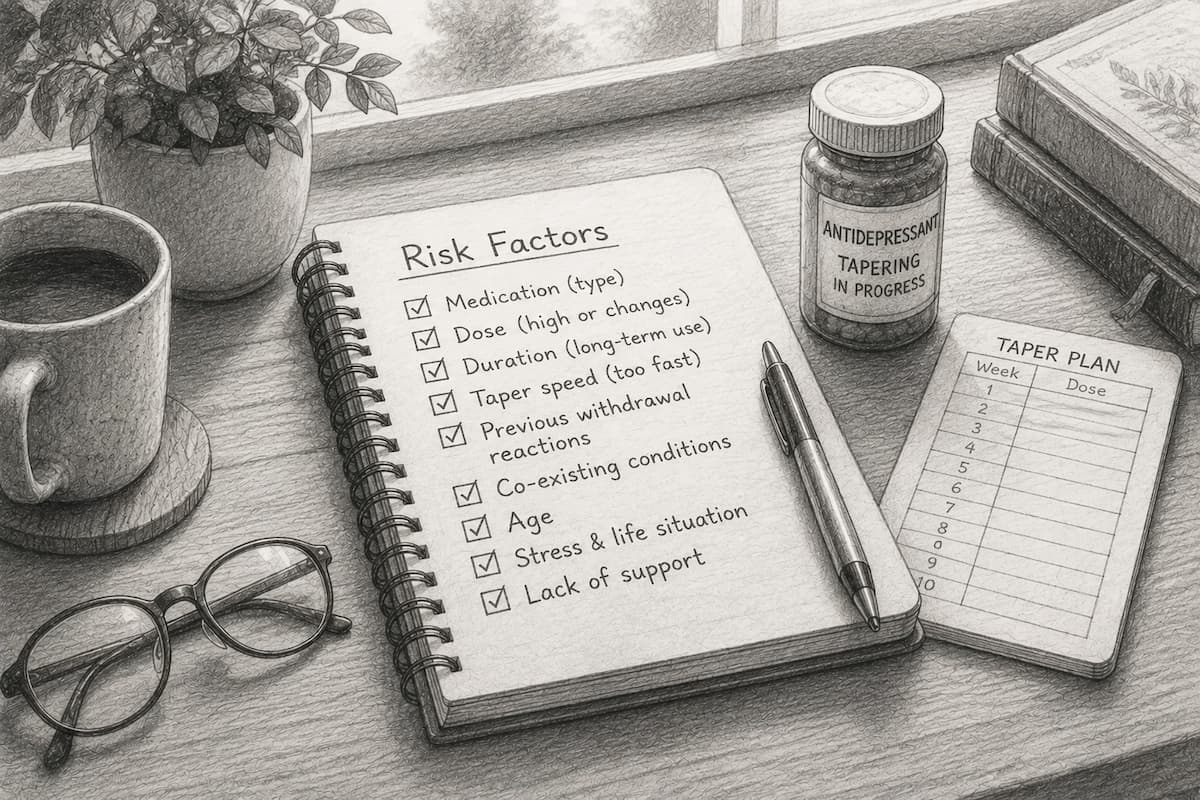
If you've taken antidepressants, you've likely heard about withdrawal—but you might not know what makes it worse. Several factors shape how hard quitting hits you: the drug you're on, how long you've taken it, your dose, even your age and sex. Some risks you can't change.
Others you can manage with the right plan. Understanding what drives severe withdrawal is the first step toward protecting yourself from it.
Key Takeaways
- Short half-life drugs like paroxetine and venlafaxine cause rapid plasma drops, triggering severe, fast-onset withdrawal symptoms.
- Higher doses deepen neuroadaptation, while longer treatment duration prolongs withdrawal, with 12% experiencing symptoms beyond a year.
- Abrupt cessation causes discontinuation syndrome in 20% of patients, with symptoms emerging within two to four days.
- Younger individuals, females, and those with high baseline anxiety face heightened vulnerability to withdrawal symptoms.
- Past difficult discontinuation episodes signal physiological sensitivity, increasing the likelihood of severe future withdrawal.
Why Drug Half-Life Drives Withdrawal Severity
When you stop or sharply reduce an antidepressant, the speed at which the drug leaves your body largely determines how quickly and how intensely withdrawal symptoms appear.
A short elimination half-life causes plasma levels to fall rapidly, creating a steep concentration gradient that strongly perturbs your monoaminergic systems.
Because your brain has adapted to chronic exposure, this sudden drop produces a mismatch between those neuroadaptations and the abruptly reduced modulation, amplifying symptom severity. Reassuringly, most withdrawal manifestations are mild and self-limiting, involving symptoms such as dizziness, headache, and sleep disturbances.
Timing follows pharmacokinetics closely. Symptoms typically emerge after roughly three to five half-lives, so short-acting agents like venlafaxine can trigger problems within hours of a missed dose, often peaking between 36 and 96 hours.
By contrast, fluoxetine's long half-life tapers you off gently, making it relatively unproblematic even with abrupt discontinuation.
Keep in mind that extended-release formulations slow absorption but not elimination, and if you're a rapid metabolizer, your functional half-life shortens, raising your risk further.
Which Antidepressants Carry the Highest Withdrawal Risk?
Although half-life explains much of the timing, the specific drug you're taking shapes just how likely and how severe your withdrawal will be. Among SSRIs, paroxetine and fluvoxamine sit in the highest-risk category.
One study found discontinuation symptoms in 50% of paroxetine-treated patients versus just 9% of those taking fluoxetine, and you might experience dizziness, electric-shock sensations, anxiety, insomnia, and flu-like symptoms after stopping abruptly.
SNRIs deserve equal caution. Venlafaxine and desvenlafaxine consistently rank among the worst offenders, often triggering rapid-onset nausea, vertigo, agitation, and "brain zaps" once you interrupt a dose. Their withdrawal frequently exceeds what you'd see with sertraline or citalopram. Notably, immediate-release venlafaxine also shows a high risk of discontinuation symptoms, reinforcing this pattern of risk across certain antidepressants.
Don't overlook escitalopram and the tricyclic imipramine, both placed in elevated-risk tiers. Imipramine can bring gastrointestinal upset, sleep disturbance, and cholinergic rebound.
How Treatment Length Shapes Your Withdrawal Odds
Duration also shapes how long symptoms linger. While many people recover within one to two weeks, roughly 30% of long-term users report withdrawal lasting more than three months, and about 12% experience it beyond a year. According to clinical data, 7% may still experience ongoing symptoms at the two-month mark.
Multi-year use also tends to produce more severe, complex symptom clusters, including anxiety, low mood, and agitation. That's why longer treatment usually calls for a slower, carefully managed taper rather than abrupt cessation to protect your wellbeing.
Why Higher Doses Make Withdrawal Harder
If you've been taking a higher dose of an antidepressant, your brain has likely undergone deeper neuroadaptation, and that's a key reason withdrawal tends to hit harder.
PET studies show that even minimum therapeutic doses occupy about 80% of your serotonin transporters, while high doses push that to roughly 85%. That extra occupancy doesn't add much benefit, but it keeps your system deep in the plateau zone, driving stronger receptor and signaling adaptations across regions like the striatum and limbic structures.
When you reduce your dose, that larger homeostatic shift has to reverse, placing more stress on neural circuits. Because of this, a tapering plan typically involves gradual dose reduction in increments, allowing 2 to 6 weeks between reductions, with clinician guidance being crucial.
Because the dose–occupancy curve is hyperbolic, standard milligram cuts can trigger disproportionately large occupancy changes as you approach lower doses. This greater pharmacologic load increases your risk of discontinuation symptoms like dizziness, sensory disturbances, and mood instability.
Understanding this helps explain why higher doses often demand slower, more carefully planned tapering.
The Danger of Quitting Antidepressants Cold Turkey
When you stop an antidepressant abruptly, you give your brain no time to readjust, and that sudden shift triggers discontinuation syndrome in roughly 20% of patients. Symptoms usually surface within two to four days, and they hit harder when you skip a taper.
Stop an antidepressant cold turkey, and your brain pays the price—discontinuation syndrome strikes roughly 20% of patients within days.
If you've been taking a short half-life drug like paroxetine or venlafaxine, your risk climbs sharply—venlafaxine can produce impaired coordination and motor problems within hours of a missed dose. You might face flu-like aches, insomnia, nausea, "electric shock" sensations, severe dizziness, and gait instability that makes safe walking and daily work difficult.
Beyond the physical toll, abrupt cessation can rapidly return depressive and anxiety symptoms, sometimes within days. These withdrawal-related mood changes mimic relapse, and research links the period shortly after discontinuation with elevated suicide-attempt risk. Abrupt discontinuation also increases the risk of relapse, particularly in people with recurrent depression or anxiety disorders.
Sometimes symptoms grow so intense that you'll need to restart the medication just to find relief.
How Fast Tapering Triggers Severe Withdrawal
Although a faster taper might seem like the quickest path to freedom from your medication, speed is precisely what turns a manageable shift into a punishing one.
When you cut your dose quickly, you produce large, sudden drops in serotonin transporter occupancy and monoamine signaling, which sharply raises your risk of severe withdrawal.
Because the dose–response curve is hyperbolic, a 50% cut near the bottom of the range strips away far more occupancy than the same cut at higher doses.
That's why linear steps like 20 mg → 10 mg → 0 mg deliver progressively bigger biological shocks, hitting hardest at the very end.
Rapid reductions compress the time your receptors and downstream pathways need to readjust, so symptoms cluster into a narrow window and feel overwhelming. This is why gradual reductions allow the brain and body to adapt effectively.
You might experience dizziness, "electric shock" sensations, insomnia, nausea, and emotional lability—rebound effects that can even mimic or exceed your original condition.
Here is an example of a hyperbolic tapering calculator to create a plan for slowly and strategically tapering off of an antidepressant.
Hyperbolic Tapering Calculator
This calculator uses a percentage-based (hyperbolic) taper. It is for educational purposes only and does not replace medical advice.
How to Taper Safely and Lower Your Risk
Because safe tapering depends on slowing down and tailoring each step to your body, you'll want to plan a gradual reduction rather than an abrupt stop. Aim to reduce your dose over at least four weeks, cutting your total daily dose by roughly 25–50% every two to four weeks, and slowing the pace if symptoms flare.
Consider a hyperbolic taper, where you make progressively smaller absolute cuts—often 5–10% steps—allowing time between changes for your brain to adjust. A prospective cohort study found that withdrawal is inversely related to taper rate, meaning a slower pace generally produces fewer symptoms. This approach matters most with SSRIs and SNRIs, where receptor occupancy drops sharply at low doses.
Liquid formulations, scored tablets, or mini doses let you make these precise reductions. If you're stopping a short half-life drug like paroxetine, your clinician might bridge you to fluoxetine, whose gradual clearance creates a natural taper.
Finally, keep a written plan with scheduled dose changes and review points, which reduces errors and supports your steady progress.
Who's Most Vulnerable to Withdrawal Symptoms?
While anyone can experience withdrawal when stopping an antidepressant, certain factors make some people far more vulnerable than others. The medication itself matters a great deal.
If you're taking a short half-life drug like paroxetine, fluvoxamine, or venlafaxine, you face a higher risk than someone on fluoxetine or vortioxetine. The severity of withdrawal symptoms is closely linked to a medication's half-life, with shorter half-life drugs potentially leading to more severe symptoms.
Not all antidepressants carry the same risk—short half-life drugs like paroxetine and venlafaxine make withdrawal far more likely.
Higher doses and longer treatment durations also increase your vulnerability, since extended use leads to greater neuroadaptation and more intense symptoms when you stop.
Demographics play a role too. If you're younger or female, research consistently shows you're more likely to experience withdrawal, including sensory disturbances, dizziness, and flu-like symptoms.
These risks compound, so a younger woman on a high dose of paroxetine faces particularly elevated odds.
Your treatment history matters as well. If you experienced adverse effects early on, or you're taking multiple psychotropic medications, you're more likely to encounter challenging withdrawal when discontinuing your antidepressant.
How Anxiety and Past Episodes Raise Your Risk
If you live with high baseline anxiety, you face a particularly challenging path when discontinuing an antidepressant, because withdrawal frequently produces the very symptoms—agitation, insomnia, irritability, and sensory disturbances—that already define your daily experience.
This overlap creates symptom stacking, raising your total burden even when each individual component stays moderate. Your heightened somatic vigilance makes you more likely to detect dizziness, palpitations, "electric shock" sensations, and gastrointestinal upset, amplifying how severe they feel.
When reassurance-seeking and catastrophic interpretations take hold, mild discomfort can escalate into panic-level episodes and emergency care. To minimize these risks, gradual tapering is advised rather than stopping your medication abruptly.
Past episodes matter too. If you've experienced difficult discontinuation before, you've demonstrated physiological sensitivity that predicts more intense future withdrawal—a recognized clinical risk factor alongside abrupt cessation, high doses, and long treatment duration.
Roughly one in 35 users endures severe symptoms, and fear of relapse can drive rapid dose changes that complicate and prolong your recovery further.
When Withdrawal Gets Mistaken for Relapse
When you reduce or stop your antidepressant and old feelings of low mood, anxiety, and poor concentration come flooding back, it's remarkably easy for both you and your clinician to conclude that your depression has returned.
The problem is that withdrawal mimics relapse almost perfectly on standard rating scales, which emphasize mood and anxiety while overlooking telltale signs like flu-like sensations, dizziness, or movement-related complaints. In fact, studies show withdrawal symptom scores correlate extremely closely with depression and anxiety scores, making the two nearly impossible to separate using these tools.
Timing is your best clue. Withdrawal usually starts within days to a few weeks of a taper step or missed dose, whereas genuine relapse tends to emerge later and more gradually after full washout.
If your symptoms fluctuate rapidly or ease within hours after reinstating your previous dose, that points strongly toward withdrawal, not recurrence.
Unfortunately, clinicians often skip documenting these temporal links, and many trials lump all post-discontinuation distress together as "relapse."
That circular reasoning can keep you on medication you don't actually need.
Why Limited Dosing Options Force Risky Cuts
Although you might assume your medication comes in whatever dose you need, the reality is that manufacturers produce antidepressants in just a handful of fixed tablet and capsule strengths. This leaves you with only large step-down options, and once you reach the lowest available dose, your next move is often a jump straight to zero.
In fact, most of the smallest tablets and capsules available in the US do not support hyperbolic tapering.
That's a problem, because serotonin reuptake inhibitors follow a hyperbolic relationship between dose and receptor occupancy: small milligram reductions at low doses produce disproportionately large changes in occupancy. A linear cut that felt manageable at higher doses can over-reduce occupancy near the end, intensifying withdrawal.
Without liquid formulations or compounding pharmacies, you can't easily make the 5–10% decrements that hyperbolic tapering recommends. So you might resort to splitting tablets, which yields inconsistent doses, or alternate-day dosing, which risks severe withdrawal from large peak-trough swings.
Limited options force cruder cuts than your pharmacology actually needs.
Looking for a more in-depth resource? The Harm Reduction Guide to Coming Off Psychiatric Drugs by Will Hall offers a harm-reduction perspective on psychiatric medications, withdrawal, and making informed decisions about coming off medications.
The guide is available free through Fireweed Collective and has been translated into multiple languages.
Frequently Asked Questions
How Long Do Antidepressant Withdrawal Symptoms Typically Last?
About 20% of SSRI users report withdrawal lasting over three months. Typically, though, you'll experience symptoms for just 1–2 weeks, starting 2–4 days after stopping. Most cases resolve within 8 weeks, though some persist longer.
Can Antidepressant Withdrawal Cause Permanent or Long-Term Health Damage?
You're unlikely to suffer permanent damage, since current evidence doesn't confirm irreversible injury. However, you might experience protracted symptoms lasting months or longer. These usually improve gradually over time, though the long-term course can vary considerably.
Are Natural Supplements or Remedies Effective for Easing Withdrawal?
You won't find strong evidence that supplements ease withdrawal. While omega-3s, magnesium, B vitamins, and vitamin D support general brain health, no direct trials confirm they reduce discontinuation symptoms. Focus on gradual tapering and professional support instead.
Is Antidepressant Withdrawal the Same as Addiction or Dependence?
No, it isn't. You're experiencing physical dependence, not addiction. Your body's adapted physiologically, triggering withdrawal symptoms when you stop. But you're not craving the drug or compulsively using it, so it's not addiction.
Can Switching to a Different Antidepressant Ease Withdrawal Symptoms?
Yes, switching can ease your withdrawal symptoms. If you're stopping a short-acting antidepressant like paroxetine or venlafaxine, your doctor might bridge you to a longer-acting one like fluoxetine, smoothing plasma levels and reducing abrupt receptor changes.