
Practical Pregabalin (Lyrica) Tapering Guide for Adults

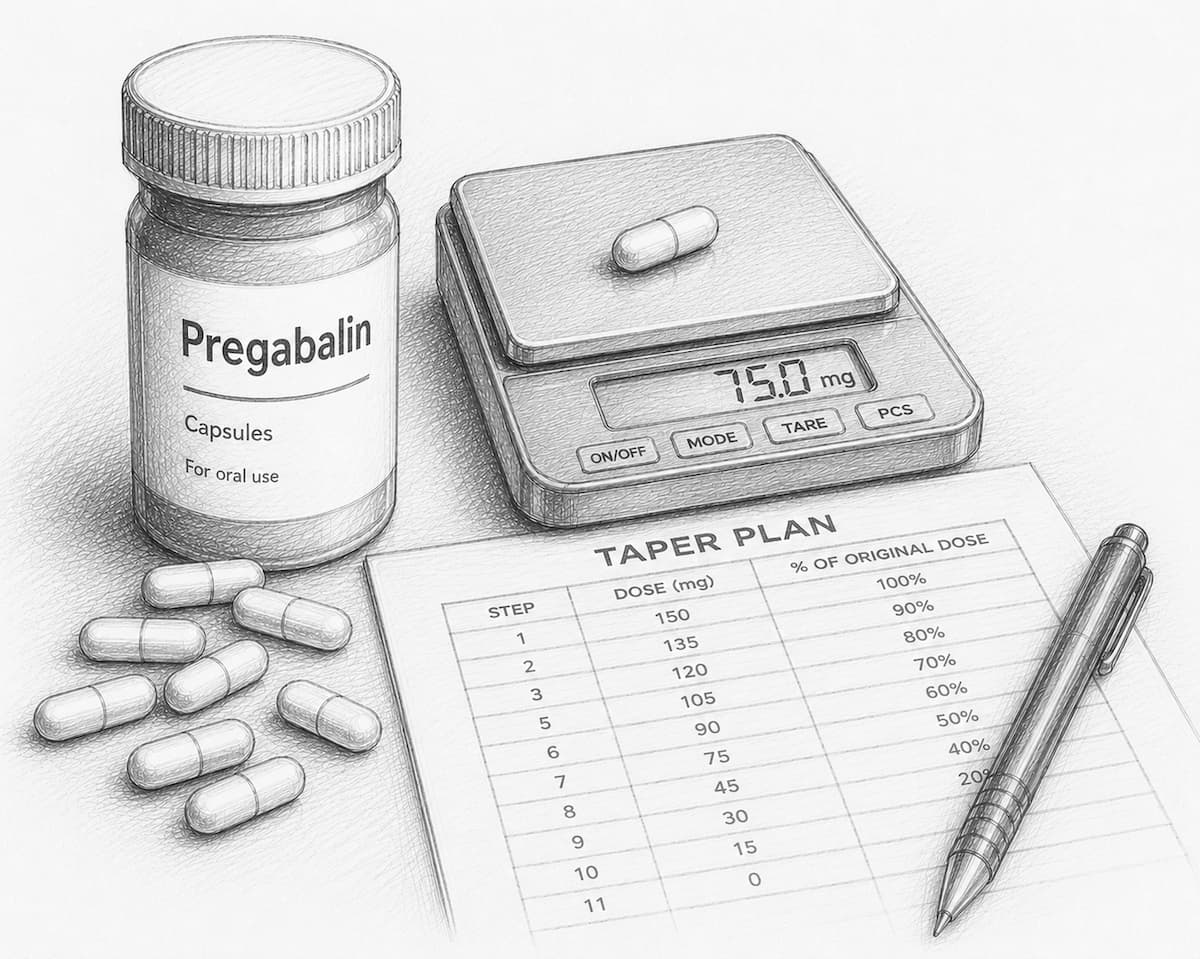
Pregabalin (Lyrica) should generally be reduced gradually rather than stopped abruptly, under the guidance of a healthcare professional. There is no single tapering schedule that will be appropriate for everyone, and research specifically examining how best to taper pregabalin remains limited.
Factors such as how long pregabalin has been taken, the current dose, previous withdrawal experiences and the person's response to dose reductions can all influence how gradually a taper may need to proceed.
Several sources provide guidance on reducing pregabalin, ranging from the Canadian product monograph's recommendation to taper over a minimum of one week to the more gradual and individualized approaches described by the National Institute for Health and Care Excellence (NICE), the Royal College of Psychiatrists and the Maudsley Deprescribing Guidelines.
The Maudsley guidelines go further by describing a hyperbolic approach, in which dose reductions become progressively smaller as the dose decreases. The table below compares these approaches before we look at each one in more detail.
Pregabalin Tapering Approaches at a Glance
| Source | Suggested Approach | Key Considerations |
|---|---|---|
| Maudsley Deprescribing Guidelines | Recommends a gradual, individualized taper and provides examples using progressively smaller reductions as the dose decreases. Example approaches generally make reductions every 2–4 weeks, with additional intermediate steps or micro-tapering considered when needed. | There is little direct research establishing an optimal pregabalin taper. The proposed hyperbolic approach is based on pregabalin's dose-effect relationship rather than direct receptor-occupancy studies. The person's response to reductions should take priority over following a predetermined schedule. |
| MedStopper | For pregabalin used for pain, gives an initial example of reducing by approximately 25% each week after more than 3–4 weeks of daily use, while allowing substantially slower reductions when needed. For epilepsy, suggests reductions of approximately 10–25% per month. | Provides examples rather than a single required schedule. The taper can be slowed if withdrawal symptoms become difficult to tolerate, and reductions may eventually need to become very small. Epilepsy requires additional consideration because of seizure risk. |
| Royal College of Psychiatrists / BAP | Recommends gradual and individualized withdrawal, planned collaboratively and adjusted according to the person's response rather than following a rigid schedule. | Factors such as dose, duration of treatment, reason for stopping and previous withdrawal experiences should help determine the pace. The guidance does not prescribe a single pregabalin tapering schedule. |
| NICE | Recommends gradually reducing gabapentinoids using a fixed amount at each dose reduction, with the schedule adjusted according to the person's response. | The rate should be acceptable and tolerable to the person. NICE recommends regular review and formulations that allow sufficiently small reductions. This differs from the hyperbolic approach proposed in the Maudsley Deprescribing Guidelines. |
| Canadian Product Monograph | Recommends gradually tapering pregabalin over a minimum of one week rather than stopping it abruptly. | Warns about withdrawal symptoms and convulsions following abrupt or rapid discontinuation but does not provide a percentage reduction or dose-by-dose tapering schedule. |
Why Are These Pregabalin Recommendations So Different?
There is no single universally accepted tapering schedule for pregabalin, largely because there has been relatively little research examining how pregabalin should be tapered. The Canadian and U.S. product information provides broad advice to taper over a minimum of one week, while MedStopper offers practical percentage-based examples that can be slowed considerably when needed.
NICE recommends fixed-amount reductions for gabapentinoids, while the Royal College of Psychiatrists and British Association for Psychopharmacology emphasize gradual, individualized withdrawal guided by the person's response.
The Maudsley Deprescribing Guidelines go further by proposing a hyperbolic approach, based on the apparent relationship between pregabalin dose and clinical effect. Under this approach, reductions become progressively smaller as the dose decreases. However, this has not been established through direct pregabalin receptor-occupancy studies or clinical trials comparing hyperbolic tapering with other approaches.
These recommendations should therefore be understood as different frameworks for planning a pregabalin taper rather than competing prescriptions for one correct schedule. The limited evidence also makes individual response particularly important when determining the size and timing of reductions.
What Do the Maudsley Deprescribing Guidelines Suggest for Tapering Pregabalin?
The Maudsley Deprescribing Guidelines emphasize that there has been relatively little research specifically examining how to taper gabapentinoids such as pregabalin. Rather than presenting a single fixed schedule, the guidelines recommend a gradual, flexible and individualized taper, with the rate of reduction adjusted according to the person's response.
The guidelines cite local UK hospital guidance recommending reductions of approximately 50 mg every 1–4 weeks. From a dose of 600 mg/day, this type of approach could take roughly 3–12 months, although the authors emphasize that some people may require considerably longer tapers. From the maximum licensed dose of 600 mg, a taper using this type of fixed reduction would take approximately 3–12 months. The authors caution, however, that some people may require considerably longer tapers and that fixed milligram reductions may become increasingly difficult to tolerate as the dose becomes lower.
A central recommendation in the Maudsley Deprescribing Guidelines is to consider hyperbolic tapering. The authors explain that the relationship between the dose of a gabapentinoid and its clinical effects appears to be hyperbolic rather than linear.
At higher doses, additional milligrams produce relatively smaller changes in effect, while at lower doses, comparatively small changes in dose may produce much larger changes in effect.
This means that a taper using the same milligram reduction throughout—for example, repeatedly reducing by 50 mg—may result in progressively larger changes in effect toward the end of the taper. A hyperbolic taper instead involves making smaller and smaller reductions as the dose decreases, potentially continuing to very small doses before stopping completely.
The guidelines emphasize that tapering should be guided by tolerability rather than a predetermined schedule. Dose reductions can be adjusted or postponed when withdrawal symptoms become difficult to tolerate, and the person's experience and preferences should be given priority.
The authors illustrate this principle with a published case involving gabapentin. A patient taking 1,200 mg/day initially could not tolerate a reduction to 900 mg but could tolerate a reduction to 1,000 mg. They subsequently reduced by 100 mg per month until reaching 300 mg/day, after which those reductions became intolerable. Reductions were then decreased to 20–30 mg per month, and at 100 mg/day they could tolerate reductions of only about 5 mg per month. They ultimately stopped at 60 mg/day—approximately 5% of her original dose—after an 18-month taper.
Although this case involved gabapentin rather than pregabalin, the Maudsley Deprescribing Guidelines use it to illustrate the broader principle that withdrawal can become increasingly difficult at lower gabapentinoid doses and that progressively smaller reductions may therefore be required.
The guidelines also recommend responding to withdrawal symptoms rather than simply continuing according to the calendar. If symptoms become intolerable, the reduction schedule can be slowed or adjusted. They note that withdrawal symptoms can sometimes be mistaken for a return of the original condition—particularly anxiety or pain, since both can occur during gabapentinoid withdrawal.
Overall, the Maudsley Deprescribing Guidelines favour a patient-led, gradual and flexible approach, with the possibility of increasingly small reductions toward the end of the taper rather than assuming that the same size reduction will remain equally tolerable all the way to zero.
What Does MedStopper Suggest for Tapering Pregabalin?
MedStopper provides different pregabalin tapering suggestions depending on why the medication is being taken. In particular, it distinguishes between pregabalin used for pain and pregabalin used for epilepsy, reflecting the different risks that may need to be considered when reducing the medication.
For people taking pregabalin for pain, MedStopper suggests that if it has been used daily for more than 3–4 weeks, the dose may initially be reduced by 25% each week. It notes that the taper can be slowed considerably if needed, giving examples of reductions of 1–25% every 2–50 weeks.
If intolerable withdrawal symptoms develop—typically 1–3 days after a dose reduction—MedStopper suggests returning to the previously tolerated dose until symptoms resolve and then planning a more gradual taper. It also notes that reductions may eventually need to become very small, giving 2.5% of the original dose as an example.
For people taking pregabalin for epilepsy, MedStopper recommends a more cautious approach of reducing the dose by 10–25% each month. If seizure activity occurs, it suggests returning to approximately 75% of the previously tolerated dose. Because reducing an anticonvulsant in someone with a seizure disorder involves considerations beyond withdrawal symptoms alone, changes should be planned with the prescribing clinician.
An important feature of MedStopper's guidance is that it does not present a single pregabalin tapering schedule for everyone. The indication for treatment, response to dose reductions and development of withdrawal symptoms can all affect how the taper proceeds.
What Does the Canadian Product Monograph Say About Tapering Pregabalin?
The Canadian product monograph for pregabalin recommends gradually tapering pregabalin over a minimum of one week rather than stopping it abruptly.
The monograph specifically warns that abrupt or rapid discontinuation can produce withdrawal symptoms, including insomnia, nausea, headache, anxiety, excessive sweating and diarrhea. Convulsions, including status epilepticus and grand mal convulsions, have also been reported in people without epilepsy during treatment or following abrupt discontinuation.
The recommendation to taper over a “minimum of one week” should not be interpreted as meaning that everyone can comfortably discontinue pregabalin within one week. The monograph does not provide a percentage-based taper, a dose-by-dose schedule, or guidance for people who experience significant withdrawal symptoms during a reduction.
Later in this article, we will look at more detailed deprescribing guidance and why some people may require a considerably slower and more individualized taper.
In Canada, pregabalin capsules are available in 25 mg, 50 mg, 75 mg, 100 mg, 150 mg, 200 mg, 225 mg and 300 mg strengths. These available strengths are an important practical consideration when making progressively smaller dose reductions, particularly toward the end of a taper.
What About U.S. Prescribing Information?
Current U.S. prescribing information for Lyrica similarly recommends tapering pregabalin gradually over a minimum of one week rather than stopping it abruptly. The label reports that abrupt or rapid discontinuation has been associated with insomnia, nausea, headache, anxiety, excessive sweating and diarrhea.
It also warns that rapid discontinuation may increase seizure frequency in people with seizure disorders. Suicidal behaviour and suicidal thoughts have also been reported following discontinuation of pregabalin.
U.S. prescribing information is particularly useful from a practical tapering perspective because Lyrica is available not only as 25 mg, 50 mg, 75 mg, 100 mg, 150 mg, 200 mg, 225 mg and 300 mg capsules, but also as a 20 mg/mL oral solution. FDA Access Data The availability of a liquid formulation can make smaller dose reductions possible when commercially available capsule strengths become too large for the desired reduction.
What Do Other Clinical Guidelines Recommend?
Royal College of Psychiatrists
In 2025, the Royal College of Psychiatrists and British Association for Psychopharmacology published a joint position statement specifically addressing the use and withdrawal of gabapentinoids, including pregabalin. The guidance recognizes that physical dependence and withdrawal can occur with prescribed gabapentinoids and recommends planning withdrawal collaboratively with the person taking the medication.
The guidance emphasizes that tapering should be gradual and individualized, taking into account factors such as the dose, duration of treatment, reasons for stopping and the person's previous experience of withdrawal. The pace can be adjusted according to the person's response rather than following a rigid schedule.
National Institute for Health and Care Excellence (NICE) Guidelines
NICE guidance on medicines associated with dependence or withdrawal symptoms recommends gradually reducing pregabalin rather than stopping it abruptly. Unlike its recommendations for antidepressants, benzodiazepines and Z-drugs, NICE recommends reducing gabapentinoids by a fixed amount at each dose reduction rather than using proportional reductions that automatically become smaller as the dose decreases.
NICE also emphasizes that the taper should be individualized. The rate of reduction should be acceptable and tolerable to the person, reductions should be reviewed regularly, and the schedule can be modified if withdrawal symptoms become difficult to tolerate.
NICE also recommends considering formulations that allow people to make sufficiently small dose reductions and giving them some control over the pace of the taper.
NICE acknowledges that withdrawal symptoms can sometimes be difficult to distinguish from a return of the condition for which the medication was originally prescribed. If symptoms occur after a dose reduction, factors such as their timing, whether they are different from the person's original symptoms, and whether entirely new symptoms appear can help distinguish withdrawal from recurrence.
The evidence supporting specific pregabalin tapering schedules remains limited. NICE's evidence review identified pregabalin withdrawal studies, but these do not establish an optimal tapering rate or demonstrate that one particular reduction schedule is best.
National Health Service (NHS) Guidance
The NHS also advises against suddenly stopping pregabalin, noting that abrupt discontinuation can cause withdrawal symptoms such as anxiety, difficulty sleeping, nausea, pain and sweating. It recommends gradually reducing the dose to reduce the risk of withdrawal symptoms and withdrawal-related seizures.
What Could a Hyperbolic Taper of Pregabalin Look Like?
A hyperbolic taper does not mean reducing pregabalin by the same number of milligrams at every step. Instead, the reductions become progressively smaller as the dose decreases, with the aim of producing more consistent changes in the medication's clinical effect throughout the taper.
The Maudsley Deprescribing Guidelines provide pregabalin-specific examples based on the apparent hyperbolic relationship between pregabalin dose and clinical effect. Unlike some psychiatric medications, there are no direct neuroimaging studies establishing pregabalin receptor occupancy at different doses. The guidelines instead use available dose-response data, including anticonvulsant effects, to estimate how the relationship between dose and effect may change across the dose range.
Their moderate example (i.e., moderate tapering speed) begins at 600 mg/day and progresses through 28 dose steps, with reductions, generally, every 2–4 weeks. Selected doses from the example illustrate how the absolute size of the reductions becomes progressively smaller:
| Selected Daily Dose | What It Illustrates |
|---|---|
| 600 mg | Starting dose in the moderate Maudsley example |
| 375 mg | A relatively large reduction at the higher end of the dose range |
| 225 mg | Dose reductions begin becoming progressively smaller |
| 150 mg | Smaller absolute reductions as the taper progresses |
| 100 mg | The regimen continues with increasingly small dose changes |
| 50 mg | Reductions become considerably smaller at lower doses |
| 26 mg | Small doses are used toward the lower end of the regimen |
| 14 mg | Progressively smaller reductions continue |
| 8 mg | Very small doses may require a liquid formulation |
| 4 mg | Very small reductions near the end of the example |
| 2 mg | Final low dose before stopping in the example |
| 0 mg | Final step |
One practical consequence of this approach is that commercially available capsule strengths may eventually become too large to make the desired reductions. The guidelines therefore discuss options such as liquid pregabalin, compounded preparations and carefully prepared smaller doses when very small reductions are required.
Pregabalin Tapering Calculator
The Maudsley example above illustrates one approach to constructing progressively smaller pregabalin reductions. The calculator below provides another way to explore this general principle by applying a percentage reduction to the previous dose at each step.
The calculator uses a proportional percentage-based calculation. It does not estimate pregabalin's clinical effect, receptor occupancy or reproduce the schedules in the Maudsley Deprescribing Guidelines.
The calculator generates an example schedule in which each reduction is calculated from the previous dose rather than the original starting dose. This naturally causes the reductions to become progressively smaller as the dose decreases.
You can change the settings and regenerate the schedule to see how different reduction percentages or intervals affect the overall taper. The results are intended as an educational planning tool rather than individualized medical advice, and calculated doses may not always correspond to commercially available or practically measurable pregabalin doses.
Tapering Calculator
Explore how progressively smaller dose reductions can look using a percentage-based taper. Each reduction is calculated from the previous dose rather than the original starting dose.
How Does Pregabalin Work, and Why Might This Matter During Tapering?
Pregabalin is structurally related to gamma-aminobutyric acid (GABA), but despite its name and structure, it does not primarily work by directly activating GABA receptors. Instead, pregabalin binds to the alpha-2-delta (α2δ) subunit of voltage-gated calcium channels in the nervous system. This reduces the release of several excitatory neurotransmitters and decreases neuronal excitability.
With ongoing use, the nervous system may adapt to the presence of pregabalin. When the medication is reduced or stopped, these adaptations may take longer to reverse than it takes for pregabalin itself to leave the body. The Maudsley Deprescribing Guidelines describe this neuroadaptation as a plausible explanation for why withdrawal symptoms can continue after the medication has been eliminated, although the specific biological mechanisms underlying pregabalin withdrawal have not been well studied.
Pregabalin has an elimination half-life of approximately 6 hours, meaning blood levels can change relatively quickly following a missed dose or substantial reduction. This is one reason the Maudsley authors advise against using alternate-day dosing as a tapering strategy. Rather than skipping doses to lower the average amount taken, they recommend reducing the daily dose while maintaining regular dosing intervals, as large fluctuations in pregabalin levels may contribute to withdrawal symptoms.
Why Smaller Pregabalin Reductions May Matter at Lower Doses
The relationship between pregabalin dose and its pharmacological effects appears to be non-linear. The Maudsley Deprescribing Guidelines describe a hyperbolic relationship between pregabalin dose and clinical effects, drawing in part on dose-response data for its anticonvulsant effects.
At higher doses, relatively large changes in dose may produce comparatively smaller changes in effect, while at lower doses, increasingly small changes in dose may produce proportionally larger changes.
There have been no neuroimaging studies directly measuring gabapentinoid receptor occupancy. The Maudsley authors therefore infer the relationship between dose, receptor effects and withdrawal from pharmacological principles and available dose-response data.
They propose that this non-linear relationship may help explain why equal milligram reductions can become more difficult as the dose gets lower, but this remains a pharmacologically informed model rather than a finding established through clinical trials comparing tapering methods.
This is the rationale behind the hyperbolic pregabalin tapering examples described earlier. Rather than reducing pregabalin by the same number of milligrams at every step, the reductions become progressively smaller toward the end of the taper. The guidelines also emphasize that these schedules are examples rather than fixed prescriptions and that some people may require additional intermediate steps, longer intervals between reductions or even smaller dose changes depending on their experience of withdrawal.
How to Get Smaller Pregabalin Doses
One practical challenge with a gradual pregabalin taper is that the required doses may eventually become smaller than those readily available as standard capsules. In Canada, pregabalin capsules are available in 25 mg, 50 mg, 75 mg, 100 mg, 150 mg, 200 mg, 225 mg and 300 mg strengths. This can make increasingly small reductions difficult using commercially available capsules alone.
There are several ways smaller pregabalin doses may sometimes be produced, including liquid formulations, compounded preparations and carefully prepared doses from capsule contents. Pregabalin is highly soluble in water, and there are anecdotal reports on the internet of people opening immediate-release capsules and dispersing their contents in water as one possible method when smaller doses are required.
Another option is a compounding pharmacy, which may be able to prepare smaller-dose capsules, suspensions or solutions. This may become particularly useful toward the lower end of a gradual taper, where the difference between successive calculated doses can be only a few milligrams. Availability varies by location, and any manipulation or compounding of pregabalin should be discussed with a pharmacist or other qualified healthcare professional.
The Maudsley guidelines also advise against using every-other-day dosing to create a lower average dose. Immediate-release pregabalin has an elimination half-life of approximately 6.3 hours, so skipping doses can produce substantial fluctuations in blood levels and may contribute to interdose withdrawal symptoms. Maintaining regular dosing intervals while reducing the amount taken each day provides more consistent exposure.
What Can Affect a Pregabalin Taper?
There is no single pace of tapering that will suit everyone taking pregabalin. Research examining the optimal way to taper pregabalin remains limited, and the Maudsley Deprescribing Guidelines emphasize that a person's response to dose reductions should ultimately guide the pace rather than following a predetermined schedule from beginning to end.
Factors that may influence how a pregabalin taper is approached include:
- How long pregabalin has been taken. Longer-term use is one factor that may lead to consideration of a more gradual approach. People who have taken pregabalin for only a short period may sometimes be able to reduce more quickly.
- The current dose. Higher doses may be associated with greater withdrawal risk, while the proposed non-linear relationship between pregabalin dose and clinical effect means progressively smaller reductions may become particularly useful toward the lower end of a taper.
- Previous withdrawal experiences. Someone who has previously experienced significant withdrawal from pregabalin or other medications may benefit from a more cautious initial reduction and slower subsequent changes.
- Response to each reduction. The Maudsley Deprescribing Guidelines recommend waiting until withdrawal symptoms have largely resolved before making another reduction. If symptoms are persistent or difficult to tolerate, holding the dose longer or making smaller subsequent reductions may be appropriate.
- Why pregabalin is being taken. Pregabalin is used for several different conditions, including neuropathic pain and epilepsy. In people taking it for seizure disorders, reducing an anticonvulsant requires particular medical oversight because abrupt or rapid discontinuation can increase seizure risk.
- Available formulations. The ability to make progressively smaller reductions can depend on the capsule strengths, liquid preparations or compounded doses that are practically available.
- Kidney function and other health considerations. Pregabalin is eliminated primarily through the kidneys, and its clearance is closely related to renal function. Kidney impairment can therefore affect pregabalin exposure and dosing and should be considered with the prescribing healthcare professional.
- Other medications. Other medications can complicate the interpretation of symptoms during a taper. Particular caution may be warranted when pregabalin is taken alongside other central nervous system depressants, including opioids, because of the increased risk of sedation and respiratory depression.
- Life circumstances and support. Stress, sleep disruption, changes in pain or anxiety, major life events and the availability of practical or emotional support may all affect how manageable the tapering process feels.
A pregabalin taper therefore does not necessarily need to remain unchanged once it has begun. Holding at a dose for longer, adding intermediate steps, making a smaller next reduction or otherwise adjusting the pace in response to withdrawal symptoms and individual circumstances can all be part of a gradual, individualized tapering process.
Pregabalin Withdrawal Symptoms
Pregabalin withdrawal can involve a range of physical, gastrointestinal, sleep-related and psychological symptoms. The Canadian product monograph lists several symptoms reported following abrupt or rapid discontinuation, while the Maudsley Deprescribing Guidelines describe a broader range of symptoms reported with gabapentinoid withdrawal. Possible symptoms include:
| Symptom Category | Possible Withdrawal Symptoms |
|---|---|
| Gastrointestinal & Autonomic | Nausea, diarrhea, sweating, increased sweating (hyperhidrosis), palpitations |
| Neurological & Physical | Headache, dizziness, tremor, flu-like symptoms, pain |
| Sleep | Insomnia, difficulty sleeping |
| Mood & Psychological | Anxiety, nervousness, restlessness, agitation, depression |
| Potentially Serious | Seizures (convulsions), including reports following abrupt discontinuation |

Looking for a more in-depth resource? The Harm Reduction Guide to Coming Off Psychiatric Drugs by Will Hall offers a harm-reduction perspective on psychiatric medications, withdrawal, and making informed decisions about coming off medications.
The guide is available free through Fireweed Collective and has been translated into multiple languages.
Frequently Asked Questions About Tapering Pregabalin
Withdrawal or a Return of the Original Condition?
It is not always easy to distinguish pregabalin withdrawal from the return of symptoms for which the medication was originally prescribed. This can be particularly difficult when pregabalin has been used for anxiety or pain, since both can also occur during withdrawal.
The timing can provide useful clues. Symptoms that begin shortly after a dose reduction, are different from the person's previous symptoms, or include new physical symptoms such as sweating, nausea, dizziness or insomnia may be more suggestive of withdrawal. There is no single symptom or test that can reliably distinguish withdrawal from recurrence in every case.
This distinction matters because interpreting withdrawal symptoms as a return of the original condition could lead someone to conclude that they still require the medication when the symptoms may instead be related to the reduction itself.
What If Withdrawal Symptoms Increase During the Taper?
Yes. I’d keep these fairly concise since most readers reaching the FAQ will already have encountered the detailed explanations above. I’d also rename the first three slightly so they read naturally as actual questions.
How Can I Tell Pregabalin Withdrawal From a Return of the Original Condition?
It is not always easy to distinguish pregabalin withdrawal from the return of symptoms for which the medication was originally prescribed. This can be particularly difficult when pregabalin has been used for anxiety or pain, since both can also occur during withdrawal.
The timing can provide useful clues. Symptoms that begin shortly after a dose reduction, are different from the person's previous symptoms, or include new physical symptoms such as sweating, nausea, dizziness or insomnia may be more suggestive of withdrawal. However, there is no single symptom or test that can reliably distinguish withdrawal from recurrence in every case.
This distinction matters because interpreting withdrawal symptoms as a return of the original condition could lead someone to conclude that they still require the medication when the symptoms may instead be related to the reduction itself.
What If Withdrawal Symptoms Increase During a Pregabalin Taper?
If withdrawal symptoms become difficult after a dose reduction, the taper does not necessarily need to continue on its original schedule. The Maudsley Deprescribing Guidelines recommend allowing symptoms to largely resolve before making another reduction.
Depending on the circumstances, this might mean holding the current dose for longer, making the next reduction smaller or adding intermediate steps. For severe withdrawal symptoms, the guidelines also discuss returning to a previously tolerated dose before attempting a slower reduction.
Significant or concerning symptoms should be discussed with a healthcare professional. Seizures, severe confusion, suicidal thoughts or other potentially dangerous symptoms require prompt medical attention.
How long does it take to taper Pregabalin?
There is no established length of time that a pregabalin taper should take. The Canadian product monograph recommends tapering over a minimum of one week, but this is a minimum discontinuation recommendation rather than evidence that everyone can comfortably stop pregabalin within a week.
The Maudsley Deprescribing Guidelines provide example schedules using reductions every 2–4 weeks, meaning a gradual taper could take several months or longer. They emphasize that these schedules are examples rather than fixed prescriptions. Someone who has taken pregabalin for a short period may be able to taper considerably faster, while someone experiencing significant withdrawal may require a much longer process.
What is the lowest dose of Pregabalin?
In Canada, the lowest commercially available pregabalin capsule strength is 25 mg. Other available capsule strengths include 50 mg, 75 mg, 100 mg, 150 mg, 200 mg, 225 mg and 300 mg.
25 mg does not necessarily have to be the final dose before stopping. When smaller reductions are needed, options such as compounded preparations or appropriately prepared smaller doses may sometimes allow doses below the smallest commercially manufactured capsule strength.
Can Pregabalin capsules be split?
Pregabalin capsules cannot be split in the same way that a scored tablet can. Immediate-release pregabalin capsules contain powder, and the Maudsley Deprescribing Guidelines discuss opening capsules and dispersing their contents in water as one possible way of preparing smaller doses.
The guidelines note that pregabalin itself is highly water soluble but caution that the stability of a homemade preparation cannot be assured. They therefore describe these preparations for immediate use rather than storage. A pharmacist should be consulted before opening or manipulating a specific pregabalin product.
Can you take Pregabalin every other day when tapering?
The Maudsley Deprescribing Guidelines advise against every-other-day dosing as a method of tapering pregabalin. Pregabalin has a relatively short elimination half-life of approximately 6.3 hours, so skipping an entire day can produce large fluctuations in drug levels.
Instead, the guidelines recommend maintaining regular dosing intervals while gradually reducing the daily dose. This is intended to provide more consistent exposure and reduce the possibility of withdrawal
References
Absolutely. I’d keep it close to the academic style of your imipramine reference section, but because this article draws on more direct evidence, I’d include the two particularly relevant primary papers as well.
References
Accord Healthcare Inc. (2024). ACH-Pregabalin: Product monograph. Health Canada.
Delahoy, P., Thompson, S., & Marschner, I. C. (2010). Pregabalin versus gabapentin in partial epilepsy: A meta-analysis of dose-response relationships. BMC Neurology, 10, 104. https://doi.org/10.1186/1471-2377-10-104. PubMed Central (PMC)
Horowitz, M. A., & Taylor, D. M. (2024). The Maudsley deprescribing guidelines: Antidepressants, benzodiazepines, gabapentinoids and Z-drugs. John Wiley & Sons. Wiley Online Library
Ishikawa, H., Takeshima, M., Ishikawa, H., Ayabe, N., Ohta, H., & Mishima, K. (2021). Pregabalin withdrawal in patients without psychiatric disorders taking a regular dose of pregabalin: A case series and literature review. Neuropsychopharmacology Reports, 41(3), 434–439. https://doi.org/10.1002/npr2.12195. Wiley Online Library
MedStopper. (n.d.). MedStopper: A deprescribing resource for healthcare professionals and their patients. University of British Columbia.
National Health Service. (2026). How and when to take pregabalin. NHS. nhs.uk
National Institute for Health and Care Excellence. (2022). Medicines associated with dependence or withdrawal symptoms: Safe prescribing and withdrawal management for adults (NICE guideline NG215). NICE
Royal College of Psychiatrists & British Association for Psychopharmacology. (2025). Gabapentinoids in psychiatric practice: Balancing the risks and benefits (Position Statement PS03/25). Royal College of Psychiatrists. www.rcpsych.ac.uk
U.S. Food and Drug Administration. (2025). Lyrica (pregabalin): Prescribing information.
This article is intended for educational purposes only and should not be considered medical advice. Psychiatric medication tapering should be discussed with a qualified healthcare professional familiar with your medical history and current circumstances. Withdrawal experiences can vary significantly between individuals. Information on this website is not intended to diagnose, treat, or replace individualized medical or psychiatric care. If you are experiencing severe symptoms, worsening mental health, or thoughts of self-harm, seek immediate medical attention or contact emergency services.