
Practical Escitalopram Tapering Guide For Safer Withdrawal

Isn’t it strange how something that once felt like a lifeline can become a heavy anchor? If you’re thinking about tapering off escitalopram, you’re not alone, and it’s vital to approach this journey carefully.
Gradual reduction is key to minimizing those pesky withdrawal symptoms that can sneak up on you.
You might be wondering what to expect, and trust me, it’s not just about cutting back; there’s a lot more to this process that can make all the difference.
Key Takeaways
- Gradually reduce doses by 10-25% every 2-4 weeks under medical supervision to minimize withdrawal symptoms.
- Use a pill cutter for precise dose adjustments, especially at lower levels.
- Keep a detailed log of mood and symptoms to monitor progress and make necessary adjustments.
- Be aware of withdrawal symptoms like dizziness and mood swings, which may start 27-33 hours after the last dose.
- Prioritize self-care through rest, hydration, and nutrition during the tapering process.
This article is intended for educational and informational purposes only.
Why Tapering Escitalopram Is Crucial for Your Health
Tapering off escitalopram isn’t just a recommendation; it’s a necessity for your well-being. You see, jumping into abrupt discontinuation can feel like stepping off a cliff—you’re likely to crash into withdrawal syndrome, which can hit hard with dizziness, irritability, and even flu-like symptoms.
It’s like your body suddenly forgets how to balance its serotonin levels, causing chaos in your mood and physical health. Research shows that taking a slow and steady approach over months not only eases these symptoms but also reduces the risk of depression or anxiety creeping back in.
Think of tapering as giving your brain the time it needs to adapt, like gently easing into a warm bath instead of diving into ice-cold water. Withdrawal symptoms may lead patients to restart medication, further complicating their recovery journey.
Consider Hyperbolic Tapering for Escitalopram
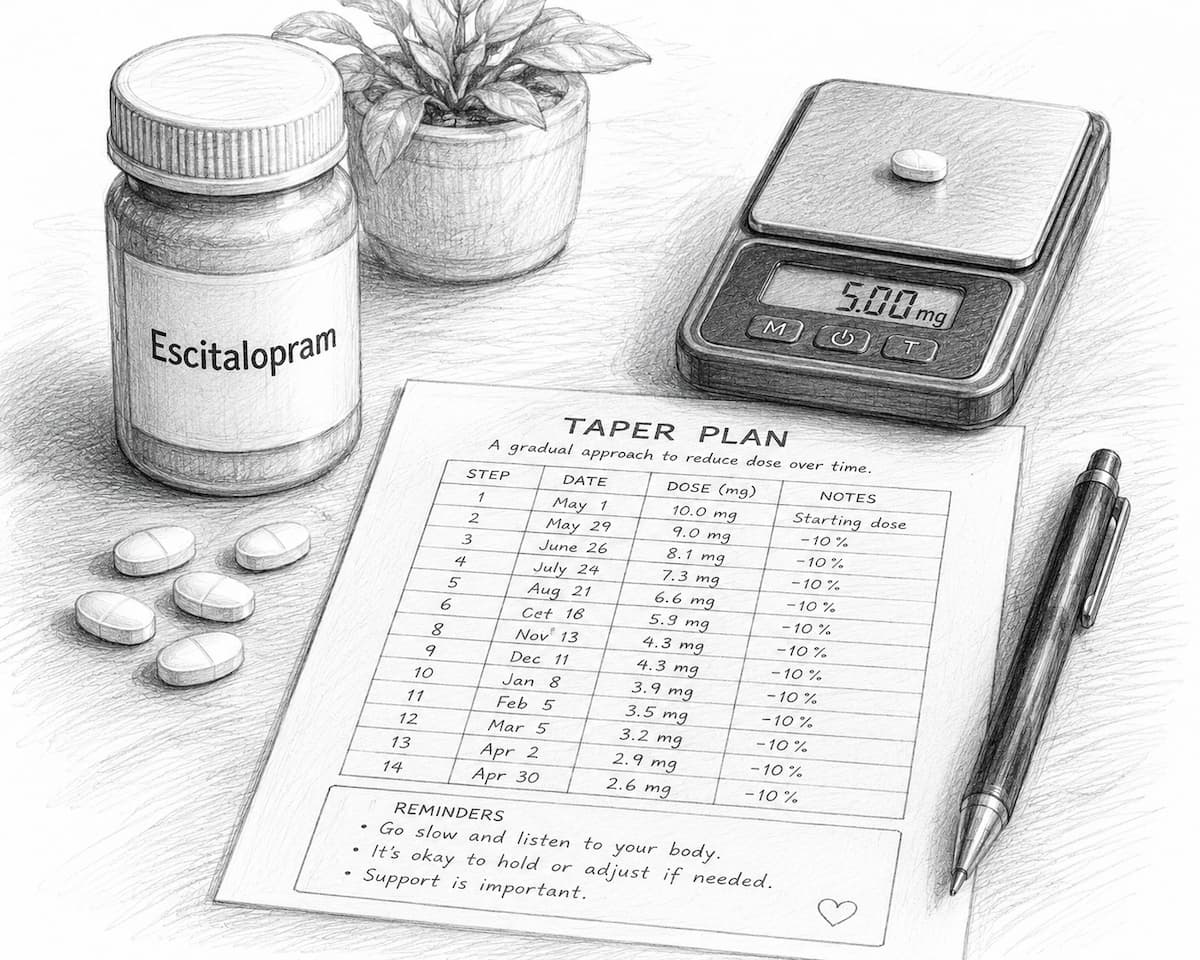
Hyperbolic tapering is a gradual and methodical way of reducing psychiatric medications. Rather than cutting the dose by a fixed amount each time, reductions are made by a consistent percentage, so the decreases become smaller as the dose gets lower.
This approach aims to reduce withdrawal effects by more closely aligning with how medications affect brain receptors, which follows a nonlinear (hyperbolic) pattern.
A commonly used guideline is to decrease the dose by about 10% every four weeks.
Below is a free calculator you can use to create a printable hyperbolic tapering schedule.
Hyperbolic Tapering Calculator
This calculator uses a percentage-based (hyperbolic) taper. It is for educational purposes only and does not replace medical advice.
Your Guide to Tapering Escitalopram Effectively
Stepping away from escitalopram can feel like walking a tightrope, where each careful move demands balance and patience. You’ll want to keep your doctor close, as medical supervision can be essential during this journey.
Gradual dose reductions—about 10-25% every 2-4 weeks—are your best bet. Think of it as peeling an onion: layer by layer, not all at once. A pill cutter can help you make those precise adjustments, especially as you approach lower doses like 5mg or even 2.5mg. It’s crucial to remember that proper guidance can significantly enhance your tapering experience.
It’s important to personalize your tapering pace; everyone’s experience is different. Keep a log of your mood and symptoms to guide your path.
If withdrawal feels too intense, don’t hesitate to pause or even reinstate your dose temporarily.
This is a marathon, not a sprint.
Give yourself the time you need, and embrace the support around you. You’re not alone in this.
What to Expect: Withdrawal Symptoms and Management?
As you commence on this journey of withdrawal, it’s essential to understand that the path ahead can be rocky, and you might experience a whirlwind of symptoms that feel both overwhelming and disorienting.
Initially, within the first few days, you could face mild symptoms like dizziness and nausea, akin to a storm brewing on the horizon. Antidepressant Discontinuation Syndrome may affect approximately 20% of individuals during this time.
As you move into weeks one and two, the acute phase hits, and the intensity ramps up—think of it as being tossed around in turbulent waters.
You might feel brain zaps, tremors, and fatigue, like your body’s running on empty.
The emotional landscape can be just as challenging, with mood swings and anxiety crashing over you like waves. By weeks three to four, things may start to stabilize, but don’t underestimate the persistence of lingering mood fluctuations.
The Role of Medical Supervision During Tapering
While you might feel tempted to go it alone during the tapering process, having medical supervision is like having a sturdy lifeboat in choppy seas. It's vital to have that safety net, especially in the first couple of weeks after each dose reduction when symptoms can sneak up on you.
Your healthcare provider can monitor your progress, adjusting the plan if intolerable symptoms arise. They’ll help you establish a baseline by evaluating your dosage and health conditions, allowing for a tailored tapering schedule that fits your unique needs.
If you’ve tried to stop before and struggled, their guidance can make a world of difference. They won't just track your medication; they'll also keep an eye on your emotional well-being, ensuring you don’t confuse withdrawal symptoms with a relapse.
This kind of support isn’t just recommended; it’s essential for a smoother, safer journey back to health, especially since gradual tapering minimizes discomfort during withdrawal.
Practical Strategies for a Successful Tapering Journey
Tapering off escitalopram can feel like steering through a dense fog, where every step forward is shrouded in uncertainty, but with the right strategies, you can find your way.
Start by creating a gradual reduction schedule, ideally over 6 to 8 weeks, adjusting based on how your body responds. Keep an eye on withdrawal symptoms, which often creep in around 27-33 hours after your last dose.
Track your mood and physical reactions in a detailed log—this helps identify if you’re facing withdrawal or a return of old symptoms. Don't hesitate to communicate openly with your healthcare provider; they can help you navigate any rough patches. Proper tapering strategies can significantly ease the discontinuation process, making it even more manageable.
Self-care is essential, so prioritize adequate rest, hydration, and nutrition. And remember, it’s okay to pause or slow down your taper if things get too intense.
You’re not alone in this; many have walked this path and emerged stronger.

Looking for a more in-depth resource? The Harm Reduction Guide to Coming Off Psychiatric Drugs by Will Hall offers a harm-reduction perspective on psychiatric medications, withdrawal, and making informed decisions about coming off medications.
The guide is available free through Fireweed Collective and has been translated into multiple languages.
This article is intended for educational purposes only and should not be considered medical advice. Psychiatric medication tapering should be discussed with a qualified healthcare professional familiar with your medical history and current circumstances. Withdrawal experiences vary significantly between individuals. Information on this website is not intended to diagnose, treat, or replace individualized medical or psychiatric care. If you are experiencing severe symptoms, worsening mental health, or thoughts of self-harm, seek immediate medical attention or contact emergency services.