Safe Cross Tapering Of Antidepressants Explained

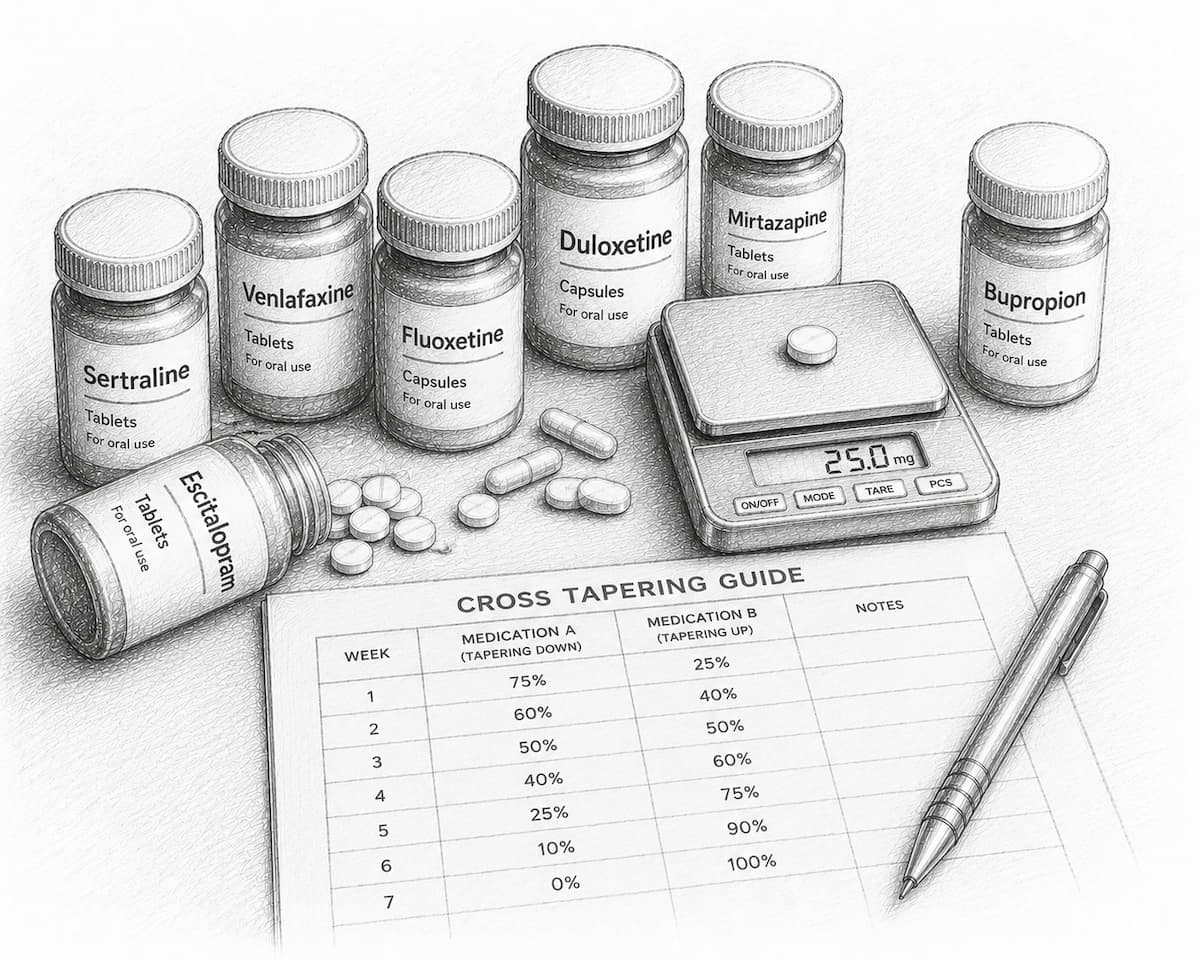
Switching antidepressants isn't like flipping a light switch—it's a careful balancing act. When you cross taper, you slowly lower one medication while gradually introducing another, usually over one to two weeks.
This approach keeps your treatment steady and helps you avoid harsh withdrawal symptoms. But timing matters, and certain drug combinations carry real risks. Before you start, there's a lot you'll need to understand about doing this safely.
Key Takeaways
- Cross tapering gradually reduces the first antidepressant by 25–50% while introducing the second at a low, upward-titrated dose.
- This method maintains therapeutic coverage and minimizes withdrawal effects, making it ideal when relapse risk is high.
- For complex cases, hyperbolic tapering reduces the outgoing drug by 10% or less, allowing two to four weeks between changes.
- Keep serotonergic load low and observe a washout period for long half-life drugs like fluoxetine to prevent serotonin syndrome.
- Elderly patients require slower tapering, under 25% every 2–3 weeks, with monitoring for hyponatremia and cognitive changes.
This article is intended for educational and informational purposes only.
What Cross Tapering Means And Why It Matters
When you switch from one antidepressant to another, the change rarely needs to be abrupt, and cross tapering offers a structured way to make that alteration safer and more comfortable.
Cross tapering means you gradually reduce and stop your first antidepressant while simultaneously starting a second one at a low dose and steadily increasing it. This concurrent rotation typically unfolds over one to two weeks or longer, depending on the medications involved.
Lower the old, raise the new—overlapping doses ease your transition over one to two weeks, sometimes longer.
Why does this matter? By overlapping the two drugs, you maintain therapeutic coverage during the change, which helps keep your symptoms under control. This is particularly relevant since roughly two-thirds of patients with major depression may not respond to their initial treatment, often requiring a switch in medication.
It's one of several recognized switch strategies, alongside direct switching, taper-and-switch, and washout approaches.
Cross tapering stands out because it lets your body adapt to differing pharmacokinetic profiles, such as half-life and receptor binding.
You'll experience fewer abrupt shifts in monoamine levels, reducing the jarring effects that sudden cessation or rapid switching can cause.
When To Cross Taper Versus Switch Directly
Although cross tapering offers real advantages, it isn't always the right choice, and knowing when to use it versus a direct switch can make the difference between a smooth change and a difficult one.
You'll favor cross tapering when relapse risk is high, when interrupting therapy would be unsafe, or when your patient has a history of significant discontinuation symptoms. It's also helpful when switching between drugs with different mechanisms, since cautious overlap lets you watch tolerability and emerging benefits in outpatient settings. Cross tapering is recommended to minimize discontinuation syndrome and symptom relapse, and typically lasts 1-4 weeks.
A direct switch, on the other hand, suits shifts between SSRIs or closely related agents with similar mechanisms and low interaction risk.
You'll choose it when intolerable side effects demand rapid change, when complex schedules threaten adherence, or when inpatient supervision allows you to manage any transient destabilization promptly.
How A Typical Cross Taper Schedule Works
A typical cross taper works by gradually reducing the first antidepressant while you simultaneously introduce the second at a low starting dose and titrate it upward toward its target.
During the initial phase, you'll usually cut the first drug by about 25–50% and begin the second at a standard low dose. As the schedule progresses, you'll lower the first agent toward its minimal dose or full cessation while raising the second toward its therapeutic level.
Most protocols span roughly 1–2 weeks, though NHS guidance often suggests 2–4 weeks, with dose changes occurring every 5–7 days so you can observe how you respond. That overlap period, when you're taking both drugs, helps minimize withdrawal symptoms while maintaining efficacy.
Throughout, schedules deliberately avoid pairing high doses of both medications, limiting additive side effects and interactions. You'll generally need slower steps for tricyclics, high-dose venlafaxine, or long half-life agents like fluoxetine. Extra caution is advised when switching from potent CYP2D6 inhibitors like fluoxetine and paroxetine, whose long half-life can cause persistent interactions for 5 to 6 weeks after discontinuation.
Slowing Your Cross Taper For Complex Cases
If your situation involves more than the usual variables, a standard one-to-two-week cross taper may simply move too fast for your body to keep up.
Several factors justify slowing things down: a history of difficult withdrawal, long-term antidepressant use, comorbid anxiety or bipolar features, recurrent depression, polypharmacy, or older age with medical complexity. Each of these reduces your margin for error and raises your destabilization risk, so you'll benefit from extended overlap between agents.
Rather than rushing, you can apply hyperbolic tapering, reducing the outgoing drug by roughly 10% or less every two to four weeks while introducing the new agent in small increments.
This pacing aligns dose steps with non-linear serotonin transporter occupancy, easing withdrawal intensity. Allowing two to four weeks between changes gives you time to stabilize and assess before continuing.
Liquid formulations, scored tablets, or compounded micro-doses make these precise, gradual adjustments practical and manageable.
Watching For Withdrawal And Relapse During A Cross Taper
Slowing your taper buys you time, but it doesn't eliminate the need to pay close attention to how you feel along the way. The key skill is telling withdrawal apart from relapse, because they call for different responses.
Withdrawal usually shows up within days of a dose change and leans toward physical signs: dizziness, "brain zaps", flu-like aches, nausea and sensory disturbances. These symptoms often fluctuate and ease when you reinstate the prior dose or slow down further.
Withdrawal arrives within days, brings physical signs like dizziness and brain zaps, and eases when you reinstate or slow down.
Relapse, by contrast, tends to emerge weeks later, bringing sustained low mood, anhedonia, returning anxiety and functional decline that persist despite a stable dose. Symptoms that last beyond a month often point to a relapse of depression rather than withdrawal.
Track your symptoms using a structured checklist and timeline, noting sleep changes, somatic clusters, neurological signs and mood shifts.
Watch venlafaxine and paroxetine especially closely, since they're linked with more severe withdrawal. If low mood, hopelessness or worsening function deepen over time, treat that as relapse, not discontinuation.
Which Drug Combinations Make Cross Tapering Dangerous
While most antidepressant switches can proceed safely with patience and careful monitoring, certain drug combinations push cross tapering from cautious to outright dangerous, and you need to recognize them before you overlap a single dose.
Monoamine oxidase inhibitors top the list: overlapping them with SSRIs, SNRIs, TCAs, or even OTC agents like 5-HTP and SAMe risks serotonin syndrome and hypertensive crisis, so you use a washout period instead.
QT-prolonging combinations come next, since pairing high-dose citalopram or escitalopram with TCAs such as amitriptyline or clomipramine produces additive QTc effects and raises torsade de pointes risk. Research analyzing 38,000 electronic medical records found a significant association between QT prolongation and high doses of citalopram and escitalopram.
Bupropion brings its own hazards, lowering the seizure threshold further when combined with TCAs, antipsychotics, tramadol, or stimulants, and inhibiting CYP2D6 enough to raise levels of other antidepressants.
When you spot any of these pairings, you'll want ECG monitoring, dose adjustments, washouts, or a safer alternative drug rather than a risky overlap.
Avoiding Serotonin Syndrome When You Switch
Because serotonin syndrome can escalate from mild agitation to life-threatening organ failure within hours, you'll want to treat it as the central hazard of any antidepressant switch. Your goal is to keep total serotonergic load low, since excess activation of 5-HT2A and 5-HT1A receptors drives the toxicity.
Minimize overlap between potent serotonergic agents, and avoid high-dose combinations during cross-tapering whenever you can. When you're stopping a long half-life drug like fluoxetine, remember its active metabolites linger for days to weeks, so you may need a washout before introducing another agent. Keep in mind that cross-tapering allows gradual dose adjustments but increases the risk of drug interactions.
Keep serotonergic agents from overlapping, and respect fluoxetine's lingering metabolites with a washout before starting something new.
With irreversible MAOIs, that caution becomes absolute: wait at least 2 weeks, because monoamine oxidase inhibition persists long after the last dose.
Watch closely during the first 24 hours after any dose increase or new agent, since that's when symptoms typically emerge. If you notice clonus, hyperreflexia, tremor, agitation, or a racing heart, seek help immediately.
Looking for a more in-depth resource? The Harm Reduction Guide to Coming Off Psychiatric Drugs by Will Hall offers a harm-reduction perspective on psychiatric medications, withdrawal, and making informed decisions about coming off medications.
The guide is available free through Fireweed Collective and has been translated into multiple languages.
Cross Tapering Safely In Elderly And Frail Patients
When you're cross-tapering antidepressants in an older or frail patient, you're working against a body that clears drugs more slowly than it once did. The same schedule that's safe for a younger adult can easily become a recipe for accumulation and toxicity.
Frailty, low body weight, and hypoalbuminemia raise free drug levels, while declining renal and hepatic function prolongs half-lives. That's why you should slow down considerably, often reducing doses by less than 25% every two to three weeks, and tapering long-term users over months rather than weeks.
Watch closely for hyponatremia, orthostatic hypotension, falls, cognitive changes, and cardiac effects, since nearly 40% of elderly patients discontinue because of side effects.
Don't rush the final step either; shifting to very low liquid or split-tablet doses softens the last drop that often triggers symptoms. Stay alert for discontinuation syndrome, including delirium, which you might otherwise misread as medical illness. Pay special attention when tapering antidepressants with short half-lives, such as paroxetine and venlafaxine, as these carry a higher risk of withdrawal symptoms.
Frequently Asked Questions
Can I Drink Alcohol During an Antidepressant Cross Taper?
Picture pouring fuel on a flickering flame—that's alcohol during a cross taper. You shouldn't drink, since it'll amplify sedation, mask emerging side effects, worsen your mood, and dangerously complicate the delicate balancing act your body's already managing.
Will Cross Tapering Affect My Ability to Drive Safely?
Yes, it can. During cross-tapering, you're exposed to two antidepressants at once, which may increase sedation, dizziness, and slowed reaction times. Stay cautious, monitor how you feel, and avoid driving if you're impaired.
How Much Do Cross Taper Antidepressant Switches Typically Cost?
You'll typically pay for overlapping medications plus clinician visits. Generic drugs cost as little as $4–$40 monthly, while visits run around $35 each. Branded options and complex switches with extra follow-ups can push your costs considerably higher.
Is Cross Tapering Safe During Pregnancy or Breastfeeding?
Think of cross-tapering like changing horses mid-stream—it's doable, but you'll need a steady hand. It can be safe during pregnancy or breastfeeding, but you'll want specialist oversight to weigh dual-exposure risks against your stability.
Can I Cross Taper Antidepressants While Taking Herbal Supplements?
You can, but you'll need close medical supervision. Some herbs like St. John's wort, 5-HTP, or ginkgo raise serious interaction risks during tapering. Always tell your doctor what you're taking so they'll monitor you carefully.
This article is intended for educational purposes only and should not be considered medical advice. Psychiatric medication tapering should be discussed with a qualified healthcare professional familiar with your medical history and current circumstances. Withdrawal experiences vary significantly between individuals. Information on this website is not intended to diagnose, treat, or replace individualized medical or psychiatric care. If you are experiencing severe symptoms, worsening mental health, or thoughts of self-harm, seek immediate medical attention or contact emergency services.