Amitriptyline Tapering Guide for Safe Withdrawal

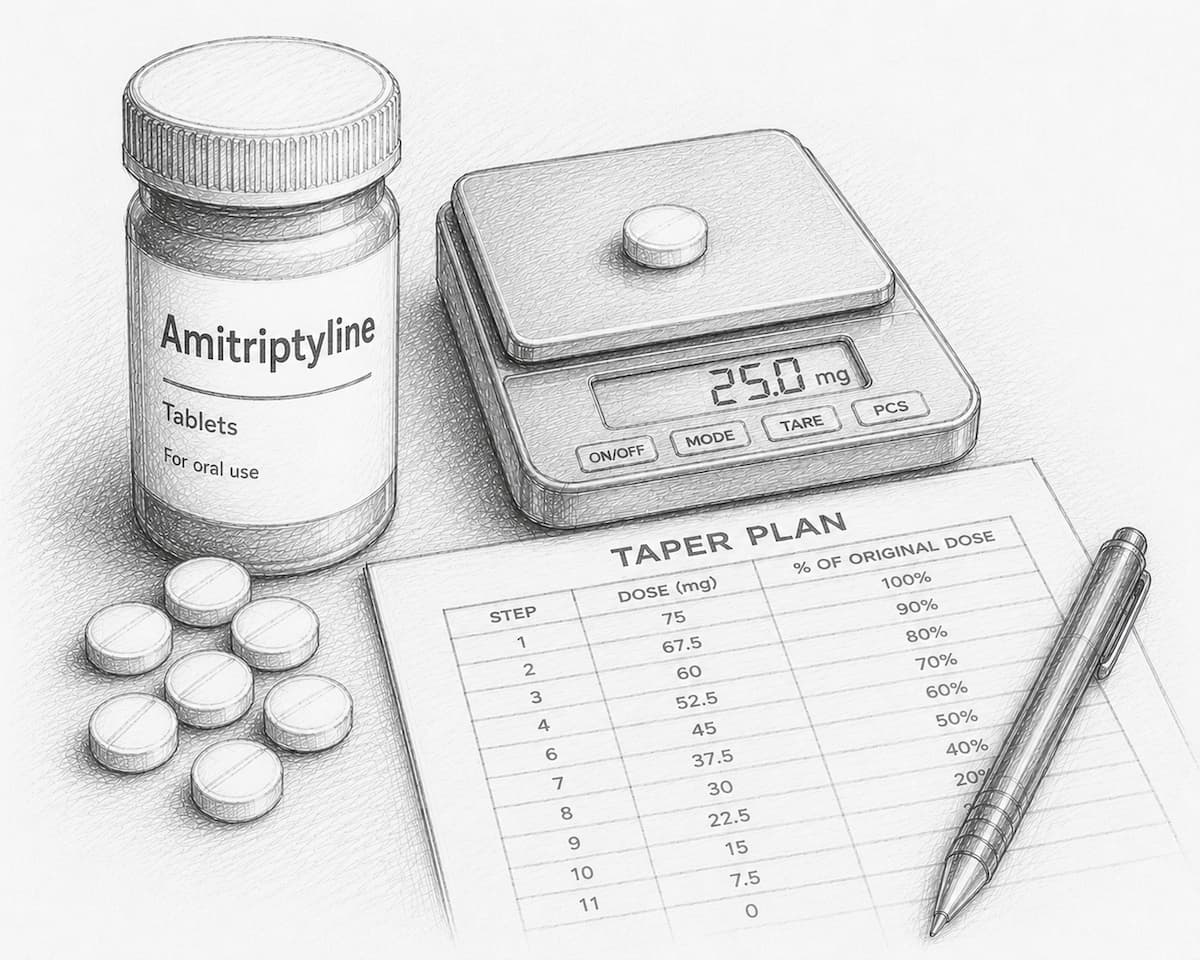
Amitriptyline should generally be reduced gradually rather than stopped abruptly, under the guidance of a healthcare professional. There is no single tapering schedule that will be appropriate for everyone. Recommendations vary considerably depending on the source, while factors such as how long amitriptyline has been taken, the current dose, previous withdrawal experiences and the person's response to dose reductions can all influence how gradually a taper may need to proceed.
Several sources provide guidance on reducing amitriptyline and other antidepressants, ranging from the Canadian product monograph's general recommendation for gradual dose reduction to the much more gradual, hyperbolic approaches described in the Maudsley Deprescribing Guidelines. The table below compares these approaches before we look at each one in more detail.
Amitriptyline Tapering Approaches at a Glance
| Source | Suggested Approach | Key Considerations |
|---|---|---|
| Maudsley Deprescribing Guidelines | Provides faster, moderate and slower hyperbolic tapering examples beginning at 100 mg, with approximate durations of 5–10 months, 10–20 months and 20–40 months, respectively. Reductions are generally made every 2–4 weeks. | Amitriptyline has hyperbolic dose–receptor occupancy relationships, meaning progressively smaller dose reductions may be needed as the dose decreases. The schedules are examples rather than prescriptions and should be adjusted according to withdrawal symptoms and individual response. |
| MedStopper | For daily use longer than 3–4 weeks, suggests an initial reduction of approximately 25% per week. The rate can be slowed considerably depending on withdrawal symptoms and individual response. | If withdrawal becomes intolerable, MedStopper suggests returning to the previously tolerated dose until symptoms resolve and then proceeding more gradually. The rate of discontinuation should ultimately be controlled by the person taking the medication. |
| Royal College of Psychiatrists | For shorter-term antidepressant use, illustrates reductions of approximately 50% of the previous dose every 2–4 weeks. Smaller and slower reductions may be required for longer-term use or withdrawal difficulties. | Amitriptyline is specifically included among antidepressants for which the less intensive example may be a reasonable starting point. The taper should be adapted according to withdrawal symptoms rather than following a predetermined schedule. |
| NICE | Recommends reducing antidepressants in stages using a proportion of the previous dose. Gives examples of 50% reductions, followed by smaller reductions such as 25% as the dose becomes lower. | The speed and duration should be led by and agreed with the person taking the medication. Further reductions can be delayed until withdrawal symptoms have resolved or become tolerable. Tapering may take weeks or months. |
| Canadian Product Monograph | Advises gradual dose reduction rather than abrupt discontinuation after prolonged use. | Recognizes withdrawal symptoms but does not provide a percentage-based or dose-by-dose tapering schedule. Canadian tablet strengths for this product are 10 mg, 25 mg, 50 mg and 75 mg. |
| NHS | Recommends gradually reducing amitriptyline over several weeks rather than stopping suddenly. | A longer taper may be needed after long-term use. NHS guidance recognizes that sudden discontinuation can produce withdrawal symptoms and provides similar gradual-taper advice when amitriptyline is used for depression, pain or migraine. |
Why Are These Amitriptyline Recommendations So Different?
There is no single universally accepted tapering schedule for amitriptyline. The Canadian product monograph provides relatively broad advice to reduce the dose gradually, while MedStopper offers a practical staged approach that can be slowed considerably if needed. The National Institute for Health and Care Excellence (NICE) and Royal College of Psychiatrists (RCPsych) emphasize proportional, symptom-guided reductions that can become smaller as the dose decreases. Pasted markdown Pasted markdown Pasted markdown
The Maudsley Deprescribing Guidelines go considerably further by providing amitriptyline-specific hyperbolic tapering examples, based on the principle that the relationship between dose and occupancy of several relevant receptors is hyperbolic rather than linear. This leads to progressively smaller dose reductions as the dose becomes lower. Pasted markdown
These approaches should therefore be understood as different frameworks for planning a taper rather than competing prescriptions for one correct schedule. The appropriate pace may vary considerably depending on duration of use, previous withdrawal experiences and how the individual responds to each reduction.
What Do the Maudsley Deprescribing Guidelines Suggest for Tapering Amitriptyline?
The Maudsley Deprescribing Guidelines recommend a gradual, individualized and potentially hyperbolic taper of amitriptyline, rather than relying on the same milligram reduction throughout the taper. The authors provide several example schedules but emphasize that these should not be treated as prescriptive schedules. The pace and size of reductions should be adjusted according to the person's response.
Amitriptyline is a tricyclic antidepressant that affects several pharmacological targets, including the serotonin transporter (SERT), norepinephrine transporter (NET), alpha-adrenergic, histamine H1 and muscarinic receptors. The guidelines explain that the relationship between amitriptyline dose and occupancy of these receptors appears to be hyperbolic rather than linear.
This means that equal reductions in milligrams do not necessarily produce equal changes in pharmacological effect. As the dose becomes lower, progressively smaller reductions may be needed to produce more consistent changes in receptor occupancy.
For example, reducing amitriptyline from 100 mg to 90 mg is unlikely to produce the same pharmacological change as reducing from 20 mg to 10 mg, even though both involve a 10 mg reduction. This is one reason the guidelines favour progressively smaller dose reductions as the dose decreases, potentially continuing to doses considerably below the smallest commercially available tablet before stopping completely.
To illustrate different possible rates of tapering, the Maudsley Deprescribing Guidelines provide three example schedules beginning at 100 mg of amitriptyline. A faster example contains 10 steps, a moderate example contains 20 steps, and a slower example contains 39 steps. Reductions are generally made every 2–4 weeks, giving approximate overall durations of 5–10 months, 10–20 months and 20–40 months, respectively.
These examples become progressively more gradual as the dose falls. In the moderate schedule, for example, the first reductions move from 100 mg to 70 mg, 50 mg, 35 mg and 25 mg, while reductions later in the taper become much smaller. The final stages move through doses such as 2 mg, 1.5 mg, 1 mg, 0.6 mg and 0.3 mg before reaching zero.
The guidelines also note that some people may need an even slower approach than these examples, using smaller reductions and/or longer intervals between reductions.
Importantly, the Maudsley Deprescribing Guidelines recommend that subsequent reductions be guided by the person's response to the previous reduction. If withdrawal symptoms have largely resolved and are tolerable, another reduction may be considered. If symptoms remain significant, the next reduction can be postponed or made smaller.
The authors also discuss practical challenges with hyperbolic tapering. Commercially available antidepressant tablets are generally manufactured for therapeutic dosing rather than for making very small tapering reductions. As a result, the smallest available tablet may still represent a substantial pharmacological reduction when taken as the final dose before stopping.
For amitriptyline, the guidelines describe several methods that may allow smaller doses to be obtained, including tablet fractions, liquid formulations, dilution of liquid preparations and compounded doses. These options become particularly relevant toward the lower end of a hyperbolic taper, where the example schedules reach doses well below conventional tablet strengths. Availability of particular formulations varies by country and product.
The guidelines also recommend maintaining daily dosing rather than taking amitriptyline every other day to reduce the average dose.
Their general antidepressant guidance warns that increasing the interval between doses can produce larger fluctuations in drug levels and potentially provoke withdrawal symptoms. Instead, they favour reducing the amount taken while maintaining regular daily dosing.
Overall, the Maudsley Deprescribing Guidelines present amitriptyline tapering as a patient-led and symptom-guided process rather than a fixed countdown to zero. Their example schedules demonstrate the hyperbolic principle: larger reductions may be possible at higher doses, while increasingly smaller reductions may be required as the dose approaches zero.
What Does MedStopper Suggest for Tapering Amitriptyline?
MedStopper provides a more detailed tapering approach for amitriptyline than the Canadian product monograph. For people who have taken amitriptyline daily for more than 3–4 weeks, it suggests an initial reduction of approximately 25% per week.
However, MedStopper emphasizes that this rate can be slowed considerably when needed. It describes reductions ranging from 1–75% every 1–50 weeks, depending on how the person responds to the taper.
If intolerable withdrawal symptoms occur—usually within 1–3 days following a dose reduction—MedStopper suggests returning to the previously tolerated dose until symptoms resolve and then attempting a more gradual taper. It notes that reductions may eventually need to become very small, potentially reaching approximately 25% of the original dose per reduction.
MedStopper lists possible withdrawal symptoms including cramping, diarrhea, nausea, sweating, hot or cold flashes, headache, dizziness, flu-like symptoms, fatigue, anxiety, restlessness, difficulty sleeping, vivid dreams, tremors, muscle aches, confusion, pounding heart (palpitations), unusual movements and mood changes.
Importantly, MedStopper also notes that the rate of discontinuation should ultimately be controlled by the person taking the medication, allowing the taper to be adjusted according to their individual response.
What Does the Canadian Product Monograph Say About Tapering Amitriptyline?
The Canadian product monograph for amitriptyline advises against abruptly stopping the medication after prolonged use. It notes that sudden discontinuation may produce withdrawal symptoms and recommends reducing the dose gradually.
The monograph reports that abrupt discontinuation following prolonged administration may produce nausea, headache and malaise. It also notes that gradually reducing the dose over several weeks may produce temporary symptoms including irritability, restlessness, and disturbances of dreaming and sleep.
Unlike some medication monographs, the Canadian amitriptyline monograph does not provide a detailed percentage-based taper or a dose-by-dose withdrawal schedule. Its guidance is relatively brief and does not address how tapering might need to be modified for people who experience significant withdrawal symptoms or who have difficulty with reductions at lower doses.
The reference to reducing the dose over approximately two weeks should therefore be understood as general product-monograph guidance rather than an individualized tapering schedule. Later in this article, we will look at more detailed deprescribing guidance, including approaches in which dose reductions become progressively smaller as the dose decreases.
In Canada, this amitriptyline product is available in 10 mg, 25 mg, 50 mg and 75 mg tablets. The smallest commercially available strength listed in the monograph is 10 mg, which can become an important practical consideration when attempting to make progressively smaller dose reductions toward the end of a taper.
What About U.S. Prescribing Information?
U.S. prescribing information for amitriptyline hydrochloride also recognizes that withdrawal symptoms can occur when amitriptyline is discontinued after prolonged use.
The U.S. label reports that abrupt cessation after prolonged administration may cause nausea, headache and malaise. It also notes that gradual dose reduction has been associated with temporary symptoms occurring within two weeks, including irritability, restlessness, and disturbances of dreaming and sleep.
The prescribing information also states that these withdrawal symptoms are not indicative of addiction. Rare cases of mania or hypomania have been reported within 2–7 days after stopping chronic treatment with tricyclic antidepressants.
Unlike more detailed deprescribing guidelines, the U.S. prescribing information does not provide a percentage-based tapering schedule or specific guidance about how quickly amitriptyline should be reduced. This makes it broadly consistent with the Canadian product monograph in recognizing the importance of gradual discontinuation, while leaving the pace and size of dose reductions largely unspecified.
What Do Other Clinical Guidelines Recommend?
Royal College of Psychiatrists
The Royal College of Psychiatrists (RCPsych) guidance on stopping antidepressants recommends gradually tapering antidepressants rather than stopping them abruptly. The appropriate rate depends on factors including how long the medication has been taken, previous experiences of withdrawal and how the person responds as the dose is reduced.
Amitriptyline is specifically included by RCPsych among antidepressants for which its less intensive tapering example may be a reasonable starting point. For someone who has not been taking an antidepressant for very long, RCPsych illustrates reductions of approximately 50% of the previous dose every 2–4 weeks, followed by stopping once a low dose has been reached. This is presented as an example rather than a schedule that everyone should follow.
If withdrawal symptoms occur, RCPsych recommends adapting the taper by making smaller reductions, allowing more time between reductions, or both. For people who have been taking an antidepressant for many months or years, or who have previously experienced withdrawal, substantially slower reductions may be appropriate. The guidance emphasizes adjusting the taper according to the person's response rather than following a predetermined schedule regardless of symptoms.
National Institute for Health and Care Excellence (NICE) Guidelines
The NICE guideline on depression in adults (NG222) recommends reducing antidepressants in stages over time rather than stopping abruptly. Importantly, NICE recommends that each reduction be calculated as a proportion of the previous dose, rather than repeatedly reducing by the same number of milligrams.
NICE gives an example of reducing to 50% of the previous dose at each step, while recommending smaller reductions, such as 25%, as the dose becomes lower. If tablets or capsules cannot provide sufficiently small doses toward the end of a taper, NICE recommends considering a liquid preparation where one is available.
The guideline also emphasizes that the speed and duration of withdrawal should be led by and agreed with the person taking the medication. Withdrawal symptoms should have resolved or become tolerable before another reduction is made, and NICE explicitly recognizes that successfully stopping an antidepressant may take weeks or months.
If more severe withdrawal symptoms occur, NICE recommends considering a return to the previous dose and then attempting another reduction using smaller dose decreases at a slower rate once symptoms have resolved.
National Health Service (NHS) Guidance
The NHS guidance for amitriptyline used for depression advises against stopping amitriptyline suddenly because doing so can produce withdrawal symptoms including headache, anxiety, tiredness and difficulty sleeping.
The NHS recommends gradually reducing the dose over several weeks, with a longer taper potentially needed for people who have been taking amitriptyline for a long time.
The NHS provides separate information for amitriptyline used for pain and migraine. This guidance similarly recommends reducing the dose gradually over several weeks or longer after long-term use and notes that sudden discontinuation can produce symptoms such as nausea, muscle pain, tiredness and restlessness.
What Could a Hyperbolic Taper of Amitriptyline Look Like?
A hyperbolic taper does not mean reducing amitriptyline by the same number of milligrams at every step. Instead, the reductions generally become progressively smaller as the dose decreases, with the aim of producing smaller and more consistent changes in the medication's pharmacological effects.
The Maudsley Deprescribing Guidelines provide several amitriptyline-specific examples based on the drug's hyperbolic dose–receptor occupancy relationships. Their faster example illustrates what this can look like in practice:
| Selected Dose | What It Illustrates |
|---|---|
| 100 mg | Starting dose in the example |
| 50 mg | A large reduction at the higher end of the dose range |
| 25 mg | Absolute dose reductions begin becoming smaller |
| 10 mg | Smaller dose changes as the taper progresses |
| 3 mg | Increasingly small reductions toward the lower end |
| 1 mg | A very small dose near the end of the example |
| 0 mg | Final step |
Amitriptyline Tapering Calculator
The Maudsley example above illustrates one approach to constructing progressively smaller dose reductions. The calculator below provides another way to explore this general principle by applying a percentage reduction to the previous dose at each step. It uses a proportional percentage-based calculation rather than estimating receptor occupancy, so it should not be interpreted as reproducing the Maudsley schedules.
The calculator generates an example schedule in which each reduction is calculated from the previous dose rather than the original starting dose. This causes the reductions to become progressively smaller as the dose decreases.
You can change the settings and regenerate the schedule to see how different reduction percentages or intervals affect the overall taper. The results are intended as an educational planning tool rather than individualized medical advice, and the doses calculated may not always correspond to commercially available or practically measurable amitriptyline doses.
Tapering Calculator
Explore how progressively smaller dose reductions can look using a percentage-based taper. Each reduction is calculated from the previous dose rather than the original starting dose.
How Does Amitriptyline Work, and Why Might This Matter During Tapering?
Amitriptyline is a tricyclic antidepressant (TCA) with effects across several neurotransmitter systems. Its antidepressant effects are associated with inhibition of serotonin and norepinephrine reuptake, increasing the availability of these neurotransmitters at synapses. Amitriptyline also has substantial anticholinergic and antihistaminergic effects, contributing to its broader pharmacological profile and many of its characteristic side effects.
The Maudsley Deprescribing Guidelines describe amitriptyline as acting across several relevant targets, including the serotonin transporter (SERT), norepinephrine transporter (NET), muscarinic acetylcholine receptors, histamine H1 receptors and alpha-adrenergic receptors. Importantly for tapering, the relationship between dose and activity at these targets is not necessarily linear.
One reason this may matter during withdrawal is amitriptyline's anticholinergic activity. Muscarinic receptors normally respond to acetylcholine and are involved in functions including gastrointestinal activity, sweating, salivation and regulation of heart rate. Amitriptyline blocks muscarinic receptors, and the nervous system can adapt to this effect during ongoing treatment.
When a tricyclic antidepressant is reduced or stopped, increased cholinergic activity has been proposed as one mechanism contributing to withdrawal—a phenomenon often described as cholinergic rebound. This may help explain symptoms such as nausea, gastrointestinal disturbance, sweating and other physical symptoms following dose reduction or discontinuation.
However, amitriptyline acts on several neurotransmitter and receptor systems, and withdrawal is unlikely to be explained by a single mechanism. Cholinergic rebound should therefore be considered one possible contributor rather than an explanation for every withdrawal symptom.
Why Smaller Amitriptyline Reductions May Matter at Lower Doses
The Maudsley Deprescribing Guidelines illustrate that the relationship between amitriptyline dose and occupancy of several of its pharmacological targets is hyperbolic rather than linear. In practical terms, relatively small doses can continue to produce meaningful pharmacological effects, particularly toward the lower end of the dose range.
This means that equal reductions in milligrams do not necessarily produce equal changes in pharmacological effect. For example, a 10 mg reduction made at a high dose may represent a substantially smaller pharmacological change than the same 10 mg reduction made when only a relatively low dose remains.
This is the rationale behind the progressively smaller reductions in the Maudsley tapering examples described earlier. Rather than reducing amitriptyline by the same number of milligrams all the way to zero, the absolute size of each reduction becomes smaller as the dose decreases.
The Maudsley examples extend to doses well below the smallest commercially available tablet strength, illustrating why the final stages of a hyperbolic taper can involve particularly small doses. The authors also emphasize that these schedules are examples rather than fixed prescriptions: if withdrawal symptoms are difficult to tolerate, smaller intermediate reductions or longer intervals between reductions may be required.
How to Get Smaller Amitriptyline Doses
One practical challenge with a gradual amitriptyline taper is that the doses calculated toward the lower end of a taper may be smaller than those readily available as standard tablets. Canadian amitriptyline products are available as tablets, with 10 mg among the lowest commercially available strengths.
Several approaches may be used clinically to obtain smaller doses. Depending on the particular medication and formulation, these can include using lower-strength tablets, appropriately splitting tablets, commercially manufactured liquid formulations where available, or having smaller doses prepared by a compounding pharmacy. NICE specifically recommends considering liquid preparations when very small doses cannot be achieved using available tablets or capsules. NICE
Not every tablet can be safely or accurately divided, and the availability of liquid or compounded preparations varies by medication and location. The Royal College of Psychiatrists therefore recommends discussing methods for obtaining smaller doses with a prescriber or pharmacist, particularly when switching between tablets and liquids or when doses smaller than standard tablets are required. www.rcpsych.ac.uk
Another approach is simply to prescribe a different combination of available tablet strengths as the dose decreases. Which option is most appropriate depends on the specific product, the dose required and what formulations are locally available.
Using every-other-day dosing to create a lower average dose is generally different from reducing the amount taken each day. NICE warns that missed doses can produce withdrawal symptoms and recommends stepwise reductions based on a proportion of the previous dose; alternate-day dosing is specifically discussed as an option for fluoxetine because of its unusually long duration of action. For medications such as amitriptyline, maintaining a consistent daily dose while reducing the amount is generally the more pharmacologically consistent approach.
What Can Affect an Amitriptyline Taper?
There is no single pace of tapering that will suit everyone taking amitriptyline. How someone responds to dose reductions can vary, and a taper may need to be adjusted along the way rather than following a predetermined schedule from beginning to end.
Factors that may influence how an amitriptyline taper is approached include:
- How long amitriptyline has been taken. Longer-term use may require a more gradual approach, while people who have taken an antidepressant for a relatively short period may sometimes be able to reduce more quickly.
- The current dose. As discussed above, the relationship between amitriptyline dose and its pharmacological effects is not linear. Smaller reductions may therefore become increasingly important toward the lower end of a taper.
- Previous withdrawal experiences. Someone who has previously experienced difficult withdrawal after reducing or stopping an antidepressant may choose a more cautious approach.
- Response to each reduction. Withdrawal symptoms can provide useful information about whether the current pace is tolerable. Several guidelines recommend allowing symptoms to resolve or become manageable before making another reduction.
- Available formulations. The ability to make progressively smaller reductions can depend on the tablet strengths, liquid preparations or compounded doses that are practically available.
- Other medications and health considerations. Amitriptyline interacts with several medications and is metabolized primarily through CYP2C19 and CYP2D6. Other prescribed medications, changes to medications and health conditions may therefore affect amitriptyline exposure or complicate the interpretation of symptoms during a taper.
- Life circumstances and support. Stress, sleep disruption, major life changes and the availability of practical or emotional support may also affect how manageable the tapering process feels.
A tapering plan therefore does not necessarily need to remain unchanged once it has begun. Holding at a dose for longer, making a smaller next reduction or otherwise adjusting the pace in response to symptoms and circumstances can all be part of an individualized tapering process.
Amitriptyline Withdrawal Symptoms
Amitriptyline withdrawal can involve a range of physical, gastrointestinal, sleep-related and psychological symptoms. The Canadian product monograph specifically describes withdrawal symptoms following amitriptyline discontinuation, while broader antidepressant guidelines and the Maudsley Deprescribing Guidelines describe additional symptoms that may occur during antidepressant withdrawal. Some physical symptoms associated with tricyclic antidepressant withdrawal may also be related to the cholinergic rebound discussed earlier.
Possible symptoms include:
| Symptom Category | Possible Withdrawal Symptoms |
|---|---|
| Gastrointestinal & Autonomic | Nausea, abdominal symptoms, sweating, palpitations |
| Neurological & Physical | Headache, dizziness or unsteadiness, tiredness, malaise, muscle or joint aches |
| Sleep | Sleep disturbance, vivid or unusual dreams |
| Mood & Cognitive | Irritability, restlessness or agitation, anxiety, low mood, confusion |
Frequently Asked Questions About Tapering Amitriptyline
Absolutely. I’d keep these fairly concise because most readers reaching the FAQ will already have the detailed evidence above. I’d also be careful with the tablet-splitting question because the Canadian monograph we reviewed does not explicitly state that the tablets are scored or suitable for splitting.
How Can I Tell Amitriptyline Withdrawal From a Return of the Original Condition?
Amitriptyline withdrawal and a return of the condition for which it was prescribed can sometimes be difficult to distinguish. Timing can provide an important clue. Withdrawal symptoms often begin relatively soon after a dose reduction or stopping the medication, whereas recurrence of depression or another underlying condition may develop more gradually.
Withdrawal may also involve symptoms that are different from the person's original condition, such as nausea, headache, dizziness, sweating, unusual dreams or other physical symptoms. Improvement after returning to a previously tolerated dose can also suggest withdrawal, although this should be discussed with the prescribing healthcare professional.
The distinction is not always straightforward, particularly because amitriptyline is prescribed for several different conditions. The timing, nature and pattern of symptoms should therefore be considered together rather than assuming that symptoms following a reduction necessarily represent relapse.
What If Withdrawal Symptoms Increase During an Amitriptyline Taper?
Increasing withdrawal symptoms can be a sign that the current reductions are too large or are occurring too quickly for that individual. NICE recommends allowing withdrawal symptoms to resolve or become tolerable before making the next dose reduction.
Depending on the circumstances, this may involve remaining at the current dose for longer or making smaller subsequent reductions. For more severe withdrawal symptoms, NICE advises considering a return to the previous dose before attempting a slower taper with smaller reductions.
Amitriptyline tapering does not necessarily need to follow a predetermined schedule from beginning to end. The pace can be adjusted according to the person's response.
How Long Does It Take to Taper Amitriptyline?
There is no single length of time that is appropriate for everyone. The Canadian product monograph recommends tapering amitriptyline gradually over several weeks, while other guidelines emphasize that tapering may take weeks or months depending on the individual.
The Maudsley Deprescribing Guidelines provide considerably longer amitriptyline-specific examples. Starting from 100 mg, their example schedules range from approximately 5–10 months for the faster example to 20–40 months for the slower example, generally allowing 2–4 weeks between reductions. These are examples rather than recommended timelines for every person. Pasted markdown
How long a taper ultimately takes can depend on factors such as duration of treatment, current dose, previous withdrawal experiences and the person's response to individual reductions.
What Is the Lowest Dose of Amitriptyline?
For the Canadian amitriptyline product monograph reviewed for this article, the available tablet strengths are 10 mg, 25 mg, 50 mg and 75 mg, making 10 mg the lowest listed tablet strength for that particular product.
However, the lowest commercially available tablet strength is not necessarily the smallest dose that can be obtained. Depending on the product and local availability, smaller doses may sometimes be produced through appropriately divided tablets or pharmacy-compounded preparations.
This distinction can become important during a gradual taper because the Maudsley examples extend to doses considerably below 10 mg.
Can Amitriptyline Tablets Be Split?
It depends on the specific amitriptyline product. Tablets should not automatically be assumed to be suitable for splitting simply because a smaller dose is needed.
The Canadian product monograph reviewed for this article describes the tablets as film-coated and instructs them to be swallowed whole with water, but it does not provide clear instructions establishing that they are intended to be split. Whether a particular tablet can be divided accurately should therefore be confirmed using the product information or with a pharmacist.
Where suitable tablet splitting cannot provide the required dose, other professionally prepared formulations, such as compounded doses, may be considered.
Can You Take Amitriptyline Every Other Day When Tapering?
Generally, antidepressant tapering guidelines favour reducing the amount taken each day rather than skipping days. Taking amitriptyline every other day creates larger fluctuations in drug concentrations than maintaining a smaller daily dose.
The Maudsley Deprescribing Guidelines recommend maintaining daily dosing during antidepressant tapering rather than increasing the interval between doses. NICE similarly recommends reducing antidepressants in stages and specifically identifies alternate-day dosing as a possible strategy for fluoxetine, which has a much longer duration of action than most antidepressants.
For amitriptyline, progressively reducing the daily dose therefore more closely reflects the tapering approaches described in the guidelines than attempting to achieve a lower average dose by regularly skipping days.
References
Angita Pharma Inc. (2024). AG-Amitriptyline (amitriptyline hydrochloride tablets): Product monograph. Health Canada.
Horowitz, M. A., & Taylor, D. M. (2024). The Maudsley deprescribing guidelines: Antidepressants, benzodiazepines, gabapentinoids and Z-drugs. John Wiley & Sons.
MedStopper. (n.d.). MedStopper: A deprescribing resource for healthcare professionals and their patients.
National Institute for Health and Care Excellence. (2022). Depression in adults: Treatment and management (NICE guideline NG222).
Royal College of Psychiatrists. (n.d.). Stopping antidepressants.
Sörensen, A., Ruhé, H. G., & Munkholm, K. (2022). The relationship between dose and serotonin transporter occupancy of antidepressants—a systematic review. Molecular Psychiatry.
Thour, A., Alag, P., Patel, P., & Marwaha, R. (2026). Amitriptyline. StatPearls Publishing.
U.S. National Library of Medicine. (2026). Amitriptyline hydrochloride tablet, film coated [Drug label]. DailyMed.